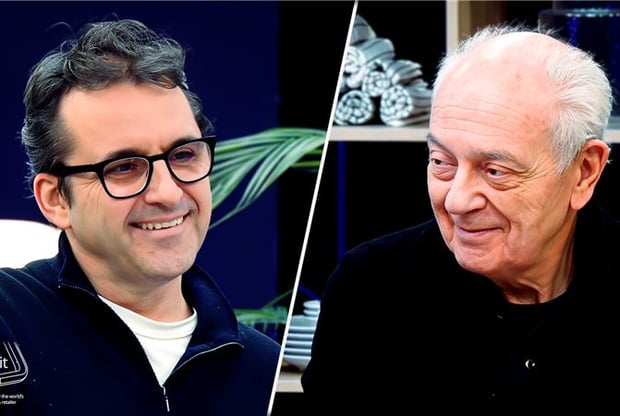
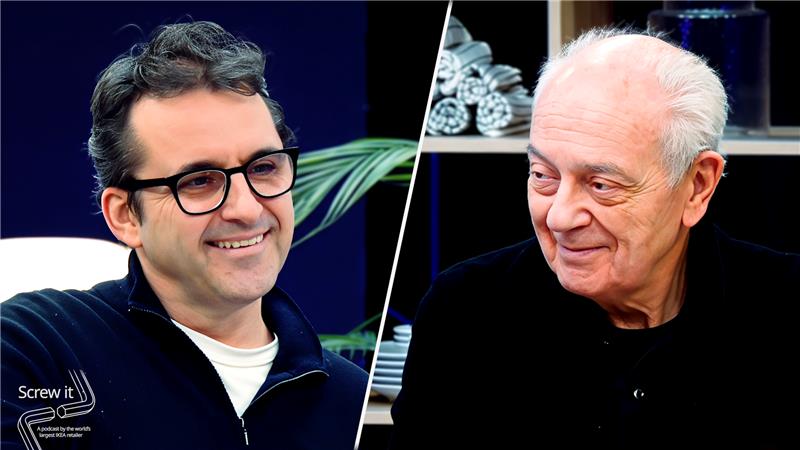
What we eat is never just about food. That is the message from Claude Fischler, guest on the new episode of Screw It, the Ingka Group podcast that looks behind the scenes of the “art of assembly” in business, sustainability, and life at home.
For more than five decades, Fischler has explored how food shapes cultures, identities, and everyday life. In this episode, he reflects on what our habits in the kitchen and around the table reveal about society today, drawing on some of the insights from the recently launched IKEA Cooking and Eating Report.
A “trivial” topic that explains how societies work
Fischler recalls that when he began his career, many social scientists dismissed food as a trivial subject, “almost frivolous”. Yet, as he points out, food is both our primary biological need and a major social force, shaping how communities organise themselves, cooperate, and share resources.
From his own multicultural upbringing, he came to see food as a kind of language, with each cuisine working like a system with its own “grammar” of what goes together and what does not. We do not just eat ingredients, he says, we eat cuisines.
To hear the full conversation with Claude Fischler, listen to episode two of Screw It.
Gender, invisible work, and the “mental load”
Reflecting on findings from the IKEA Cooking and Eating Report, Fischler notes that while roles in the home have changed, the division of labour in the kitchen has not shifted as much as many might think. Women are still more likely to plan meals, cook, clean, and carry what in France is called the “mental load” of anticipating, organising, and coordinating everything around food.
Change is happening, he says, but slowly and unevenly. In some higher-income, highly educated households, men are increasingly taking the lead in cooking and enjoying it. Yet overall, the kitchen still mirrors deeper social hierarchies.
Are we still eating together?
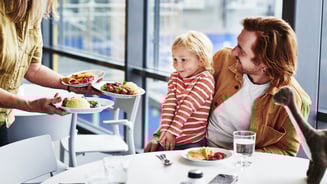
The report shows that only 44% of people eat at a kitchen table, 18% eat on the sofa, and 4% in bed, with Gen Z almost twice as likely to eat in bed. For Fischler, this is part of a broader shift: in many countries, shared mealtimes are becoming less common and eating is more fragmented and mobile.
Drawing on decades of comparative research, he contrasts cultures where people still tend to eat at fixed times and share “square meals” together, such as France and Italy, with countries like the UK and the US, where eating is more often scattered throughout the day, multitasked with other activities, and shaped by snacking and convenience.
Technology, autonomy, and anxiety
From food delivery apps to social media trends, technology is reshaping how people relate to food. Fischler links this to a longer history of individual autonomy in some cultures, where what you eat is seen as a personal choice and responsibility.
This freedom can be empowering, but it also brings pressure. People feel they must constantly make the “right” decisions about health, ethics, and the planet. Younger generations, especially Gen Z, are particularly sensitive to questions about what they are putting into their bodies and the impact of their choices.
Sustainability, waste, and unequal realities
The report highlights changing attitudes to food waste, including people who consciously choose to eat food past its expiry date or use apps to buy surplus products. Fischler welcomes the growing awareness of waste and sustainability, but also reminds us that for many people, eating expired food is not a lifestyle choice but a necessity.
He points to scenes outside his local supermarket, where unsold food is left out in containers and quickly collected by people who cannot afford to be selective. Not everyone is trying to save the planet, he says; some are simply trying to get by.
About the Podcast
Screw It is a new podcast from Ingka Group, the largest IKEA retailer, exploring the “art of assembly” in business, sustainability, and life at home. The series invites global experts and leaders to discuss how we piece together better homes and societies—even when life looks nothing like the manual. From a company that wants people to sit comfortably, but recognises that progress is often uncomfortable, Screw It ditches the corporate script to embrace the “wonderful mess” of building a better future.
About Ingka Group
With IKEA retail operations in 32 markets, Ingka Group is the largest IKEA retailer and represents 87% of IKEA retail sales. It is a strategic partner to develop and innovate the IKEA business and help define common IKEA strategies. Ingka Group owns and operates IKEA sales channels under franchise agreements with Inter IKEA Systems B.V. It has three business areas: IKEA Retail, Ingka Investments and Ingka Centres. Read more on Ingka.com.
Screw It episode 2 – Conversation transcript
Host: Paul Mills
Guest: Professor Claude Fischler
Paul:
Welcome to Screw It, the new podcast from the world’s largest IKEA retailer. I’m Paul Mills, and today I’m joined by the renowned Professor Claude Fischler. You’re a sociologist, anthropologist…?
Claude:
Social scientist.
Paul:
Social scientist, okay, if you prefer that. But you’ve spent decades exploring how food shapes cultures – eating too, eating shaping people’s identity and people’s everyday life. So your life has basically been focusing on food, or your career.
In this episode, we’re going to be talking about insights from the new study IKEA has done, the new Cooking and Eating Report that we’ve done, an insights report we’ve done with YouGov, the global data and public opinion company.
We’re going to start by talking a little bit about the report, but also talk about you a little bit, and your life. We want to start by focusing a little bit on you. You’ve spent decades – I can say decades – researching how food connects to culture, identity, and even people’s relationships. So what first drew you to the study of food?
Claude:
You know, you say I spent decades thinking about food or working on food. I mean, we all spend our whole life eating and having relationships with food. And it turns out that, looking back, I think that’s what struck me at one point: for some reason, the social sciences – I was in the social sciences – had somehow disregarded that.
They had disregarded food. I mean, the founding fathers, late 19th century and later, they were interested in food, but only in major events: big rituals and ceremonies and sacrifices and things like that. But the daily relationship to food and the procurement of food and all that was mostly neglected, except by a couple of people: a British anthropologist in the 30s, Audrey Richards, and a German sociologist, Simmel, who was more or less always a little peripheral.
Basically, it was considered trivial. It was considered a frivolous topic, almost. I remember a colleague of mine who was in Toulouse, and one day he told me the story that some big-shot sociologist from Paris visited. One older guy asked him, a little patronisingly – this was a new, younger man – “What is your topic of research?” And he says, “It’s food.” “Food? Well, you can study laundry too, you know.”
There was this idea that… and actually it’s not just the social scientists, it’s civilisation, societies, our culture, that consider it trivial. I remember another colleague saying that everything that is below the belt is considered trivial and mundane, and what’s up there is the spirit and spirituality, the terror and so on.
I didn’t realise it then, but I was digging into something that was really considered trivial and mundane, but turned out to be not just that. Everybody is prepared to accept that food is the primary biological need or determinant, okay? And it’s also a major social dimension, because why does a group of humans organise the way they do, hierarchically? The division of labour, the solidarity and everything, if not in accordance with the acquisition of resources – food – and the division of labour around that, and the cooperation.
Humans are social, but they are social for biological reasons; they are biologically social. They cooperate, and they evolved into humanity as they were cooperating, and they were cooperating around the procurement of food.
That occurred to me later, actually. I became interested in food at a very early age, probably also because I was interested in languages. For family reasons, I lived in a multicultural, multilingual environment. And I guess there was something multicultural too in the foods we had. My mother would cook French food – she was very francophile – but she had an East European background, and there were a lot of influences in that food.
So the language, the food… food is a language. It is structured like a language too, in a way. We eat not just foods, we eat cuisines. And cuisines are organised systems, with things that go together or don’t go together, that are mutually compatible or not.
Paul:
You’ve been involved and worked with IKEA now on the launch of this new report, which is globally released. I think what we’re going to do is just touch on some of the report findings now, and I’m going to ask you a few things and get your input on this.
There are some really interesting findings that have come out of this report. One of the things I’d like to talk about first is gender roles and the inequality that still exists in the home, and still in the kitchen. What we’ve seen from the report is that women – I think it was 59% – are still more likely to do the meal planning, cooking, and cleaning in the home.
So for you, with your long career, has the kitchen changed enough for you over the years in terms of the roles, or is it still a reflection of the deeper social hierarchies we have today?
Claude:
That’s a long question. It’s an interesting question. I mean, yes, it has changed, of course, but the division of labour in the home hasn’t changed as much as… I mean, of course, it’s not a novel thing that women work a little more outside the home and still have to do most of the work inside the home, as we can see in this survey.
And they have to live with what, in France, they call “la charge mentale”. I’m not sure how to translate it – the mental load – the idea that you have to deal with the responsibility of preparing, but also foreseeing, predicting, organising. That’s a kind of mental overload or load that they complain about.
Actually, in the studies we have – and this is anecdotal or observational, not based on actual data, but I think we could find some – it’s only in older people with higher income or higher education, or higher education generally, that you see that changing.
I can think of a number of households or couples around me in which the male is in charge of the cooking and loves it. It’s usually people who have a past interest. So does this predict any change? It’ll take time, obviously, but I do think it is changing. But, you know, look at salaries in businesses. They’ve been changing, but there’s a diversity across countries.
Paul:
I was going to say, you mentioned countries. Did anything surprise you in the report? I noticed that in India and Sweden there was a bit of a difference between those roles – those were two countries that I could pull out. Did anything surprise you when it came to that country breakdown, or was it something you were already aware of from a cultural perspective?
Claude:
I mean, I would not deal with comparing directly, on such limited data points, India and Britain, because they have some basic differences that it’s difficult not to take into account.
If you’ve seen the movie – what was it called? Lunchbox. It’s fascinating because it shows you how an entire system of food distribution – really just distribution – in, I think, Calcutta, or is it Bombay? Bombay, probably. The dabbawala. You know, men working in offices and the wife preparing the meal according to all these distinctions and problems, and there’s a whole system that collects the lunchbox prepared by the wife, takes it to the railway station, directly to the city where it is distributed, dispatched into the businesses at each desk, etc.
Actually, the movie The Lunchbox is about one mistake. In reality, there’s never any mistake. It’s too serious an issue. So it shows that there are cultural constraints – religious, traditional, you name it – that are so incredibly distinct that it’s difficult to compare. But of course, women’s status is changing everywhere, at different paces. It’s a good film to remember that.
Paul:
I think one of the questions I want to ask you now, a little bit from the report – and it’s probably one that anyone listening to or watching this podcast will relate to – is around how we eat together, or we don’t eat together.
One of the surprising findings, or maybe not so surprising for you, I don’t know, is that only 44% of people eat at a kitchen table. Eighteen percent eat on the sofa and 4% in bed. These are the findings. Gen Z are almost twice as likely to eat in bed.
Mealtimes today are increasingly informal and mobile – from the sofa in front of the TV or even in bed. What does this shift in eating location around the home say about how people now relate to food at home and with each other? Is eating still a shared ritual, or is it becoming less so now?
Claude:
A lot less so. It depends where. If I can compare, for instance – I have good experience of comparing cultures with respect to how they eat together or not together, the timing of meals and everything – because we did quite a number of studies over the past 25 or 30 years comparing, for instance, the US on the one hand, and France, Italy, Germany and other European countries, and the UK.
There were consistent, fundamental differences. The most different were the Americans and the French – they were the two poles. The French were eating at regular mealtimes, they were more often eating “square meals” together, and they were enjoying their food with a lot less complex issues or discomfort than the Americans, who were more worried as we started studying them. In the end, the UK was closer to the US than to the continent, as it were.
For instance, we have fascinating, huge surveys nationally organised by governments on time use. The time-use surveys of Britain and France at the beginning of the 2000s to 2010, something like that, showed some amazing differences. People keep diaries for a day or two; every 15 minutes they write down what they’re doing, what they’re busy doing. So you can reconstruct people’s schedules.
What appears there is one figure that is really striking. At any given time in 2010, I think I remember, in France at 12:30, anywhere in France, there was a huge majority – I think it was 56 or 60% of people – who were busy eating. Twelve-thirty. Now it would be later, but at that time.
If you look at the closest-in-time similar survey for the UK, they had this figure that the time of day when most people were busy eating at the same time was a little later – 1:00, 1:10 or something like that – and there were never more than 20% of people eating at the same time.
So if people eat at the same time of day, there’s a quite big likelihood that they’re eating together and sharing meals. That’s what happens in France. In the UK, it’s like in the US – we have other data – it’s scattered over the day. You take any time of day and people may be using this time to eat, snacking, nibbling – they call it “grazing” in the US sometimes.
Another study showed us what people were doing while they were eating, very similar to this survey. It turned out that American women – this was a study about women – could do anything and eat. They could do housework, they could work on their… they multitask, but with eating as the secondary task rather than the other way round.
Different cultures have different ways of dealing with the eating event. The US probably had an early experience that was already a bit associated with the pioneers who had no equipment, had no time – “Go West, young man” – and you feed on the go. Then, of course, there was an East Coast aristocracy that was modelling the European ways and was more ceremonial and strict.
But then basically they were the first, because of their immigrant population, to develop a food industry – a huge, very powerful food industry as early as the 1880s, probably. Later on, the retail system – supermarkets – were common in the States as early as the late 20s or 30s.
What happens in those supermarkets? You have to promote the cheapest foods and the ones that are most acceptable for people from very, very different cultures and origins. So it’s the smallest common denominator. And then the relationship they have to food is, because of all that, basically different from what happens in Italy or in France or, of course, in China.
Paul:
Would you say it’s a lot slower there, or more traditional in those countries? Because I think you’ve said in the past that food is not just fuel; it’s social, and it’s a social and symbolic act. Some of the things you’ve touched on – we’re living in a fast-paced world today.
Do you think food still plays a role in shaping who we are as a people and a culture, especially when these traditional meal rituals are changing?
Claude:
Well, the division of labour is changing, not just in the home across genders – never mind how slow it is in this respect, as we said – but also because there’s an industry, there’s a pre-processed set of foods that we can have available. That changes things, which means that part of the task of preparing foods has moved from the home to outside the home – to stores or to factories, and of course to restaurants.
To a large extent, that explains a lot of what we are experiencing. We don’t necessarily need to cook. We have multiple opportunities now to procure food from outside the home at various stages of preparation.
If we look at Generation Z, apparently in the survey they are the ones who like fast food most, and prefer home-delivered food – I forget, 7% or something like that – over home-cooked food overall.
Paul:
It’s funny you say Gen Z. I’ve got a daughter who’s Gen Z. It leads me into this next question, again coming from the research. My daughter is very picky. She’ll go to the fridge and see a piece of food that’s out of date, and she won’t… she probably won’t have it. She’ll say, “Oh, this is out of date, I’m not eating that.”
I think this is interesting because it links to this question about food waste. In the survey, it actually says that people in Germany lead this, with 55% saying that they’re likely to eat expired food.
We’re seeing this behaviour that used to be maybe a bit stigmatised – eating food that’s expired – and it’s now becoming a conscious choice. I live here in Sweden; there’s an app where you can buy food that is expired. You can order a bag of expired food and get it delivered to your door.
So it’s becoming a conscious choice for many people. Is this a shift towards people thinking more sustainably in terms of their choices with food? Is it a movement?
Claude:
It may be that that’s what we are led to believe, but I can’t help remembering that a number of people, including in our survey – because it’s a representative sample, as representative as possible – certainly are people who could not have a choice, actually, and they would rather eat food that is even expired. Not everybody is out to save the planet; some people are out to save themselves, after all.
But your point is right: it has become an issue. From what I see around me, for instance in my neighbourhood, there’s a small supermarket near me. Their expired foods are left outside in containers. Some is saved for food banks and some is left there, and you can see swarms of homeless people helping themselves in the evenings.
Paul:
So the next question, I’m going to start with a joke. It’s a joke that you told once.
Claude:
I did?
Paul:
Yes, you did. The joke goes like this: in a restaurant, a customer asks the head waiter, “What do you recommend for a vegetarian with an allergy to lactose, who is intolerant to gluten, and who doesn’t want to eat fish?” To which the waiter replies, “Sir, I would recommend you a taxi.” Do you remember that joke?
Claude:
Could be.
Paul:
I suppose the reason I’m asking that question is the way we live today with the internet, social media, smartphones, AI – all these things can be seen as disruptors. That’s where this question was coming from, why you told the joke.
All these things are major disruptors to how we eat and can influence us very quickly in terms of the decisions we make about food. Would you say technology is changing people’s relationship with food?
Claude:
What’s fascinating is the issue of autonomy relating to food. That’s one of the major differences between, say, the so‑called Anglo‑Saxon countries and continental Europe, typically southern Europe – particularly France, Italy, Spain, a number of other countries. Basically, differences are there.
Autonomy has been important for a long time. It probably dates back to utilitarianism and the English or Scottish Enlightenment, and to Protestant ethics. For a long time in the English‑speaking world, which is also a Protestant world in many respects, the individual has responsibility, individual freedom and responsibility.
The great sociologist Max Weber wrote about Protestant ethics. He showed that there is a distinct relationship to freedom and responsibility and to wealth, etc. The Protestant ethic requires that an individual is free and responsible directly to God, whereas Catholics have confession and this complex, obscurely organised institution that is the Church. You always find some ways to indulge.
According to the conflicts between the two religions, they have very different approaches to food. The Catholic countries have this in common: food is a communion. So it is in Italy and in France. We have huge data to document this. If you don’t eat with the rest of the group, if you don’t eat the same thing, if you don’t eat with them, you sort of excommunicate yourself. You exclude yourself from the group, and it’s a major step you have to take, and you probably hesitate to take it.
Whereas in the other tradition, you have to respect individual responsibility and autonomy. That has made the US and Britain evolve more rapidly in the direction of “what you eat is your own responsibility and decision”. It makes life easier in some ways, but more difficult in other ways.
What makes it easier is that you can decide what you eat and not eat, and nobody is going to bother you. But it makes it more difficult because you have to make choices and bear the responsibility for these choices. It’s also a moral responsibility.
What we found in interviews with Americans: they would constantly tell us, “Yes, it’s my choice, it’s my responsibility. I know what I should do. I read all the stuff, I hear the information. But somehow it’s so easy to make arrangements and just change this or that.”
The French or the Italians say, “Good quality food, together around a good table with friends and family – that’s the way to go.” It’s easier and you don’t have to worry so much. At least that was true until recently, because guilt and anxiety have grown on the continent as well. You can see that now people begin to worry.
Your favourite Generation Z seems to be particularly sensitive to this, because they have questions – more questions. They have individual biological questions. So it’s not just the planet; it’s very much the planet, but it’s also “What are we putting into our body? What is happening?” Because what you eat is what you are.
Paul:
You mentioned Gen Z, and I’m going to talk about Gen Alpha now. The report – the Cooking and Eating Report – has a section that talks about spicy foods. One thing I’ve seen over the last few years, again due to the proliferation of social media and YouTube, is this movement or fascination with spicy food.
Gen Alpha – my son is Gen Alpha – watches these “eating chilli” videos where you eat these chillies and you’ve got to prove that you can eat the hottest chilli known to humankind. There are so many of these things you can watch now.
Have you seen this? What is this fascination with spicy food now? We talk about it a little bit in the report as well – spicy food, and we talk about it per country. What is this movement?
Claude:
That’s an interesting question. In the report, in the YouGov survey, it turns out that the people who state they like spicy food most are, surprisingly, Scandinavians – the Norwegians, the Danes and the Swedes are the ones who like spicy food most.
Paul:
To warm them up in the cold?
Claude:
Maybe. But “spicy” can mean different things. I asked a Swedish colleague, “What spices can you think of?” and she said, “Thyme, dill.” But those are not spices in French or Italian; they are herbs. So what are spices? Spices are hot. There might be a translation problem or a misunderstanding in the questionnaire, in the questions asked.
What the Scandinavians seem to like is condiments, really. But there is definitely a point about what you noted. At first, I would have expected Indians and some Chinese – say in Sichuan, for instance – to report a liking for spice.
But, you know, come to think of it, if you eat within your local culture, your local cuisine in the sense I use the word, then you don’t think in terms of “cuisine”, you think in terms of “food”. It’s not “your cuisine”. Before there are restaurants from other cuisines, you don’t think of other cuisines; you eat your food. What is food? If your food is spicy, it’s spicy. It’s part of the normal experience.
We live in a different world where we’re exposed to an infinite number of other cultures and cuisines, and we’re thinking in terms of ingredients more and more, and less and less in terms of cuisines as systems or quasi‑languages with grammar and syntax. So people think in terms of ingredients.
The thing you noted about competitions among teenagers or young males in particular – who will take the hottest food, who has tasted the last… There are scores of brands of hot sauces with names I can’t remember now, but you can look them up on the internet. It’s fascinating. There are degrees – there’s a measure of the heat of the spice or the hotness of the spice. Basically, they’re probably manhood competitions. I haven’t studied the phenomenon; I might be entirely wrong about this. Maybe there are women taking part even. Some future research, perhaps.
Paul:
Perhaps. I can’t let you go without… You’ve been working with IKEA a little bit on this new IKEA Cooking and Eating Report, as I mentioned, and we’ve been talking about it. I can’t let you go without asking: what is your favourite IKEA food product or meal when you go to an IKEA store?
Claude:
I might say RÖDING or something like that… but what I sometimes procure at the local IKEA store near me – not far from me – is herring. Scandinavian herring. I was disappointed that at my hotel this morning there was no herring, because my usual routine when I’m travelling in Scandinavia with French colleagues or friends is that I make a point of eating herring at breakfast, and they look at me as if I were a Martian or something.
Paul:
And your favourite IKEA product that you’ve bought? The reason I ask is that I understand you bought a kitchen recently from IKEA. Is it meeting your expectations?
Claude:
Yes, I’m very happy with it. I’ve added some changes, some specific features myself, but yes, I’m very happy with my island. I’m happy with the furniture. But the island is a major addition to my home, and it’s changed the way we eat together.
I don’t have my children at home any more – they’ve been grown‑ups for a while – but breakfast is taken at the island, and of course any meal that includes more than two participants is taken at the table, which is a round table.
I stick to round tables because I find they’re egalitarian. There’s no hierarchy attached to the shape of the table, because even King Arthur had to have that round table to mark his pre‑eminence.
Paul:
That’s right. I have that myself at home – or a throne!
My final, final question: working over 50 years with food in different ways, what is your favourite meal you’ve ever tasted? And don’t say herring.
Claude:
I’m unable to think of one favourite. Probably my favourite meal was one I cooked recently. The most recent comes to mind first. I cooked a pot dish which I thought was amazing, because it was the dish I had cooked. I like long, slowly cooked French dishes.
This one was called beef with carrots. I had it in the oven in a pot for most of a day, I think, at very low temperature that I controlled very precisely. It turned out amazing because of the cuts I had chosen, because of the quality of the carrots, because of… I wrote it down… but basically patience. It turned out miraculous. I don’t know how to describe it. It was melting, it was full of flavours and everything. Everybody at the table was enthused, and it made my reputation as a cook, which I have to admit is totally undeserved.
Paul:
I’m sure you’re being harsh. And with that, Professor Fischler, thank you so much for joining us today. It’s been an absolute pleasure to talk to you about the report.
Claude:
Thank you.
Media enquiries
For further information, journalists and media professionals can contact us at [email protected] or by calling +46 70 993 6376.