Two IKEA employees wearing yellow striped shirts and name tags, standing together outside an IKEA store.

Ingka Group Annual Summary and Sustainability Report FY25

Social

We are determined to be a force for good by helping to create a fairer and more equal society – and better lives for our co-workers, workers in our supply chain and customers. 

A group of IKEA employees in blue and yellow uniforms walking down a staircase inside an IKEA store, with an IKEA logo visible on the wall.

What we are proud of

  • 53.4% of co-workers were women and 49.8% of co-workers in management/ leadership positions were women
  • 100% of co-workers earn equal to or above the applicable benchmark for an adequate wage in the location where they work
  • We reduced our gender pay gap to 3.4% (FY24: 4%), and maintained gender balance across Ingka Group.
  • We expanded our programmes to support equality, diversity and inclusion with a new lived experience mentorship programme that connects leaders with co-workers to mentor each other.
  • Co-worker voluntary turnover rate has reduced to 14.2%, compared with 15.6% in FY24 and 21.0% in FY23.
  • We began piloting our fair income roadmap, designed to help us support living wages in our supply chain, in collaboration with IDH – The Sustainable Trade Initiative.
IKEA warehouse worker in a yellow safety vest operating a forklift in a large storage facility with shelves filled with products.

Challenges we are addressing

  • We need to remain vigilant to ensure that new gender pay gaps do not appear due to changes in the workforce, market dynamics, mobility or hiring practices. We do this through ongoing monitoring, by applying gender-neutral pay principles in salary decisions, removing bias from recruitment practices and making leaders accountable for equal pay.
  • Collecting ethnicity data continues to be challenging due to legal restrictions in many countries. We collect data in countries where it is permitted, and where we cannot do so our managers have open dialogues to monitor progress on our diversity agenda.
  • Implementing IWAY requires strong supplier engagement, especially with those new to us. Some indirect suppliers have limited experience of responsible sourcing processes.
  • In higher risk sectors, such as facility management, construction and last mile delivery services, non-compliance rates remain higher, and we keep working to improve the working conditions.

Progress against targets

Our vision is to create a better everyday life for the many people. We set targets to keep improving and monitor and report our performance. Below you will find our social targets and latest performance data. 

Co-workers

We are committed to creating a fair, diverse and inclusive workplace where all co-workers can work safely, access fair working conditions, and thrive – no matter their background or identity.

1.
New target: 100% of co-workers earn equal to or above the applicable benchmark for an adequate wage in the location where they work (based on a full-time equivalent).
On track

Performance summary

Our annual assessment in FY25 confirmed all co-workers earn equal to or above the applicable benchmark for an adequate wage in the location where they work.

The general concepts of ‘living wage’ and ‘adequate wage’ are based on a level of wages considered sufficient to make a decent living. We define ‘adequate wage’ based on the requirements of the European Directive on Corporate Sustainability Reporting (CSRD) European Sustainability Reporting Standards (ESRS S1). We also apply recognised benchmarks to ensure our co-workers can afford a decent standard of living, such as living wage estimates published by the WageIndicator Foundation.

2.
New target: Aim to have a gender pay gap of no more than 5% and decrease it year on year.
On track

Performance summary

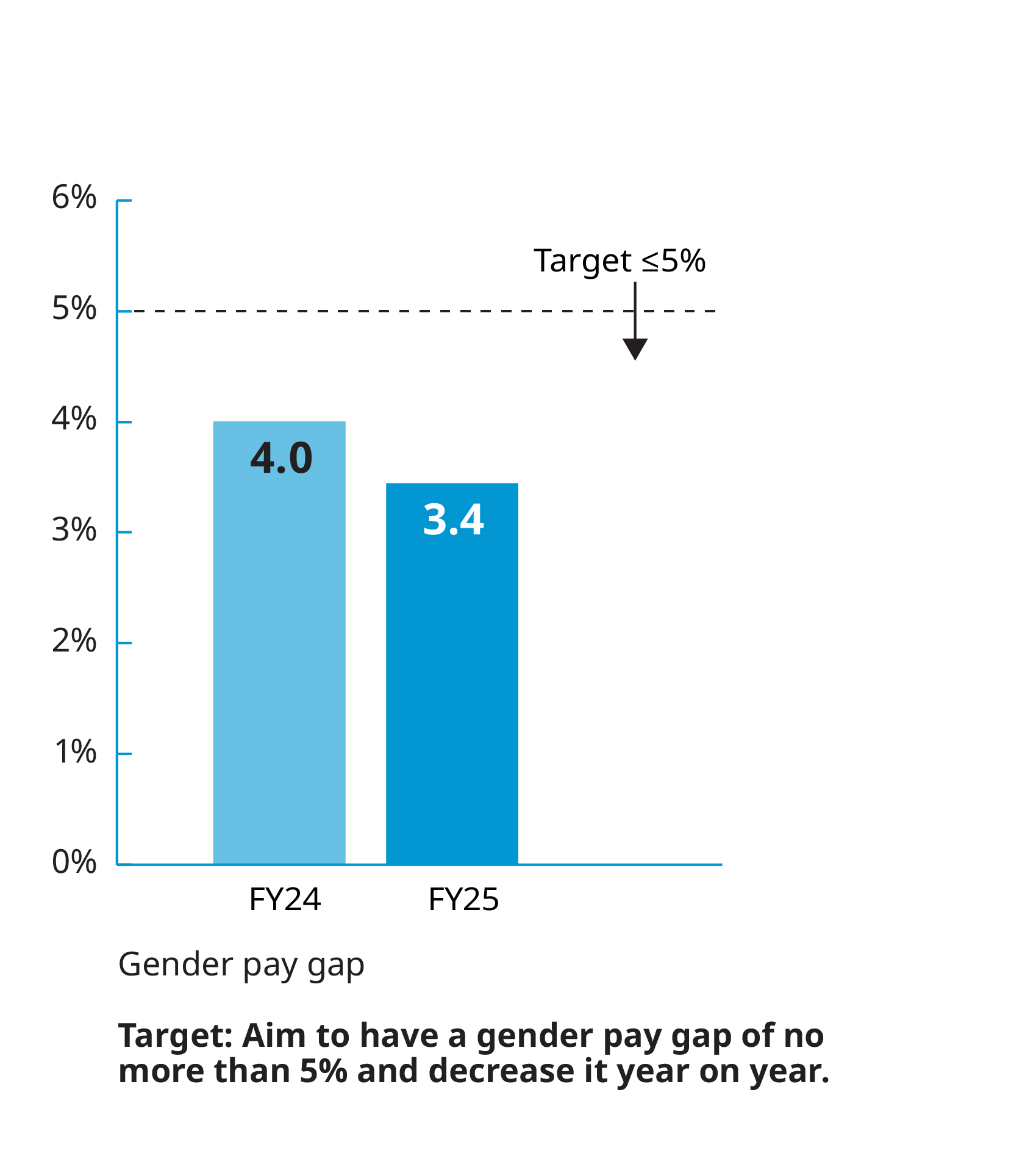
We track our gender pay gap based on the difference in average gross hourly earnings between male and female co-workers (expressed as a percentage of male gross hourly pay) in line with recognised external reporting benchmarks. Our gender pay gap was 3.4% in FY25, compared with 4.0% in FY24. Importantly, less than 0.6% of co-workers required monetary adjustments to close pay gaps, reflecting continued progress in ensuring equal pay.

Bar chart of the gender pay gap. The gap decreases from 4.0% in FY24 to 3.4% in FY25. A dashed line indicates the target to keep the gender pay gap of no more than 5%.
3.
Achieve gender balance across our business by FY27.
On track

Performance summary

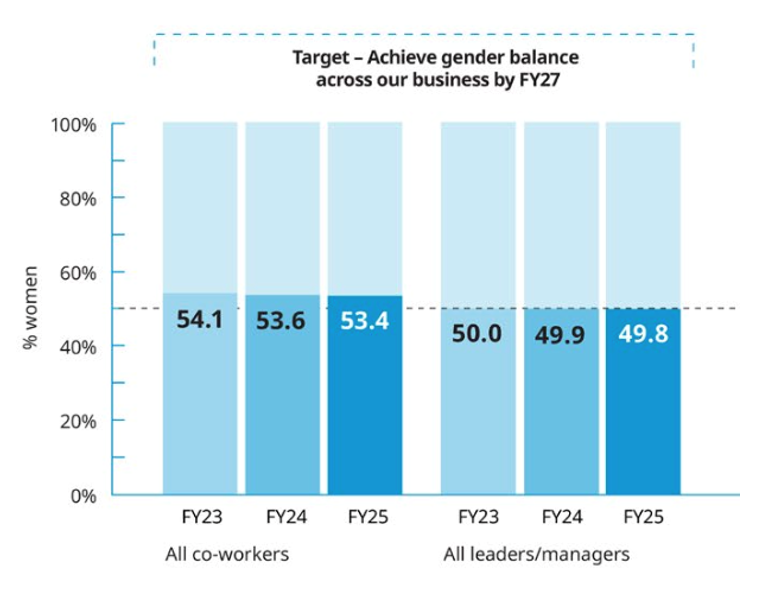
We maintained a binary gender balance (equal representation of men and women) among all co-workers (53.4% women, compared with 53.6% in FY24) and across all management/leadership positions (49.8%, compared with 49.9% in FY24). 


Grouped bar chart showing the share of women among all co‑workers and all leaders and managers from FY23 to FY25. Women represent 54.1% in FY23, 53.6% in FY24, and 53.4% in FY25 among co‑workers, and around 50% among leaders and managers across all three years. A dashed line indicates the target to achieve gender balance by FY27.
4.
Achieve gender balance across our governing bodies and senior leadership (boards) by FY27.
On track

Performance summary

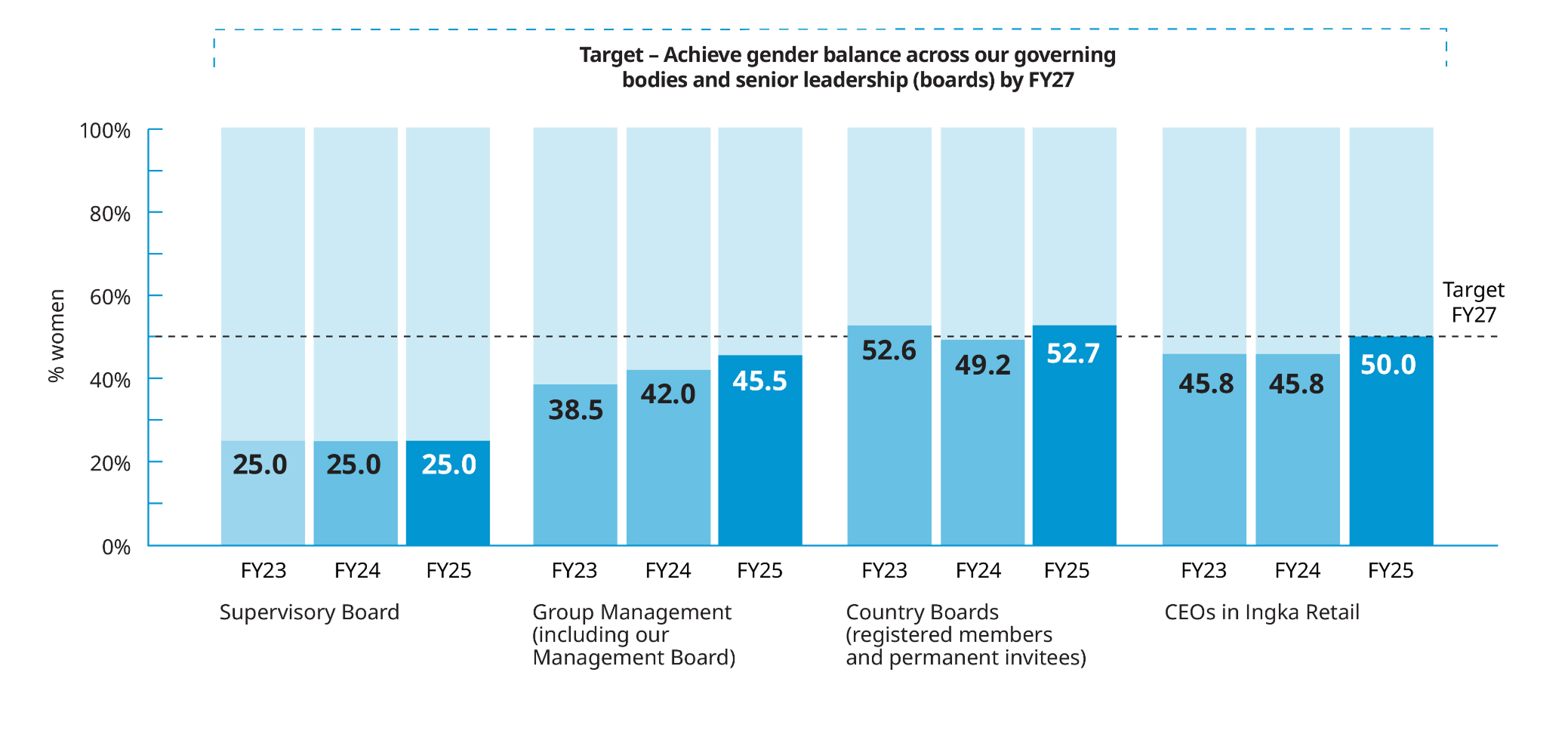
We are progressing towards our target in senior leadership, increasing representation of women to 45.5% (FY24: 42.0%) in Group Management (including our Management Board) and to 50.0% (FY24:45.8%) of CEOs in Ingka Retail. On our retail country boards, women represented 47.5% (FY24: 49.5%) of registered members and 52.7% (FY24: 49.2%) of registered members and permanent invitees. Women continued to make up 25.0% of our Supervisory Board. 

Working conditions in the supply chain

We work with thousands of suppliers to run our retail business and offices and aim to partner with those who meet our high standards. Our supplier code of conduct, IWAY, sets clear expectations on labour rights, working conditions and other aspects of sustainability, and we engage with suppliers to improve standards.

1.
We require all suppliers to continuously fulfil our IWAY expectations.
Needs improvement

Performance summary

Our suppliers are required to fulfil our IWAY expectations, and we focus our IWAY reviews on those classified as high or critical risk to monitor compliance. Of the 223 reviews we conducted in FY25, 33.2% found instances where suppliers did not fully comply with our IWAY Must criteria and we followed up to ensure suppliers addressed these. By the end of FY25, 94.6% of the 223 reviewed suppliers had either passed their reviews or closed non-compliances with IWAY Musts within the allocated timeframe. Where suppliers failed to address non-compliance with IWAY Musts, we put action plans in place to apply business consequences up to and including ending our relationship with them.

Our target is for Ingka Group suppliers only and excludes the supply chain for the IKEA range which is overseen by Inter IKEA Group.

Customer safety

We have robust procedures in place to make sure that any potential product safety issues are quickly identified and corrected and that we give customers the information they need to use our products safely.

We do not currently have a target for this material topic.

Further reading