Windmill turbines seen from a drone bird eye view

Ingka Group Annual Summary and Sustainability Report FY25

Environment

We only have one planet, the home we all share. We are committed to playing our part in tackling the challenges of climate change, biodiversity loss, resource use and water scarcity. 

Person in a denim jacket carrying a large yellow desk lamp over their shoulder, standing between tall urban buildings under a partly cloudy sky.

What we are proud of

  • Achieved a 70.6% reduction in absolute emissions from our own operations (e.g. emissions from energy use in our units and operational waste) against our FY16 baseline, and a 22.3% reduction since FY24.
  • Achieved 100% renewable electricity sourcing in India for the first time (via the purchase of energy attribute certificates).
  • Reached 60.1% of retail home deliveries made by zero emission vehicles by the end of FY25 (FY24: 41.1%).
  • Sourced almost 686,500 used IKEA products via our Buyback service (FY24: 495,000). Through this service we buy back used IKEA products that customers no longer need and resell them as second-hand via our As-Is areas.
  • Launched the IKEA second-hand marketplace (a peer-to-peer marketplace, that enables customers to buy and sell used IKEA products directly with each other) in three countries with plans to scale it up across Europe from FY26.
  • Added three more recycling companies to our circular investments portfolio, contributing towards our EUR 1 billion invested ambition.
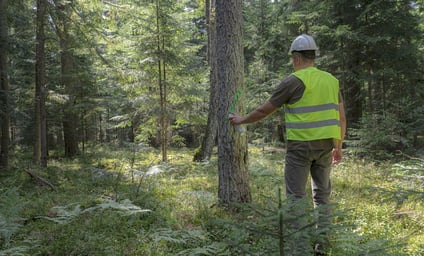
  • 94.7% of our forestland portfolio was certified by a third-party certification scheme and 5.3% was undergoing certification.
IKEA delivery van driving on a winding mountain road with snow patches and scenic valley views in the background.

Challenges we are addressing

  • Inter IKEA Group is improving how it calculates and reports climate data and can therefore not report on its FY25 footprint until later in FY26. As we rely on scope 3 data from Inter IKEA Group, our total carbon footprint for FY25 will instead be included in the Ingka Group FY26 report.
  • We rely on spend-based data to report our emissions from purchased goods and services used in our own operations, which does not reflect the progress we are making on emissions reduction.
  • Reducing the overall volume of waste generated in our operations is challenging as our business grows. Cost-effective and widely available recycling solutions are not currently available for all waste streams.
  • Expanding circular services, scaling up our second-hand offer and increasing circular resource flows remain challenging due to regulatory, logistical and infrastructure challenges, customer expectations and the need to develop new capabilities and ways of working within Ingka Group.

Progress against targets

We are guided by our belief that business can – and should – be a force for good. Sustainability drives performance and business resilience. We set targets to keep improving and monitor and report our performanceBelow you will find our environmental targets and latest performance data. 

Climate change

The world is not currently on track to limit global warming to 1.5°C in line with the Paris Agreement. We want to contribute to decisive and fast action to help address this. We are committed to achieving net zero across our value chain and to using our size and reach to help accelerate climate action beyond our business.

1.
SBTi near-term target: Reduce absolute scope 1, 2 and 3 GHG emissions by 50% by FY30 from a FY16 base year.
On track

Performance summary

Greenhouse gas emissions data from Inter IKEA Group is used to calculate many of our scope 3 emissions categories (categories 1, 4, 11, 12). Inter IKEA Group is continuously working to strengthen its climate data. This supports the company to advance accountability and drive meaningful change. A key focus is on improving how the company calculates and reports climate data, following a deliberate, step-by-step approach. Part of this process is the move towards reporting aligned more closely with CSRD, starting with the Inter IKEA Group FY25 Sustainability Statement in January 2026. As Inter IKEA Group continues to enhance its processes and systems, climate data for FY25 will not be included in reporting until the publication of the Inter IKEA Group FY26 Annual Report in November 2026.  As a result we are not able to report progress against the full Ingka Group value chain footprint or target for FY25.  

In FY24, the last year for which we have data for our full climate footprint, we had achieved a 30.1% reduction in absolute emissions (vs FY16) against our SBTi target of 50% by FY30. 

Note: this is a science-based target (approved by the SBTi in 2024).

2.
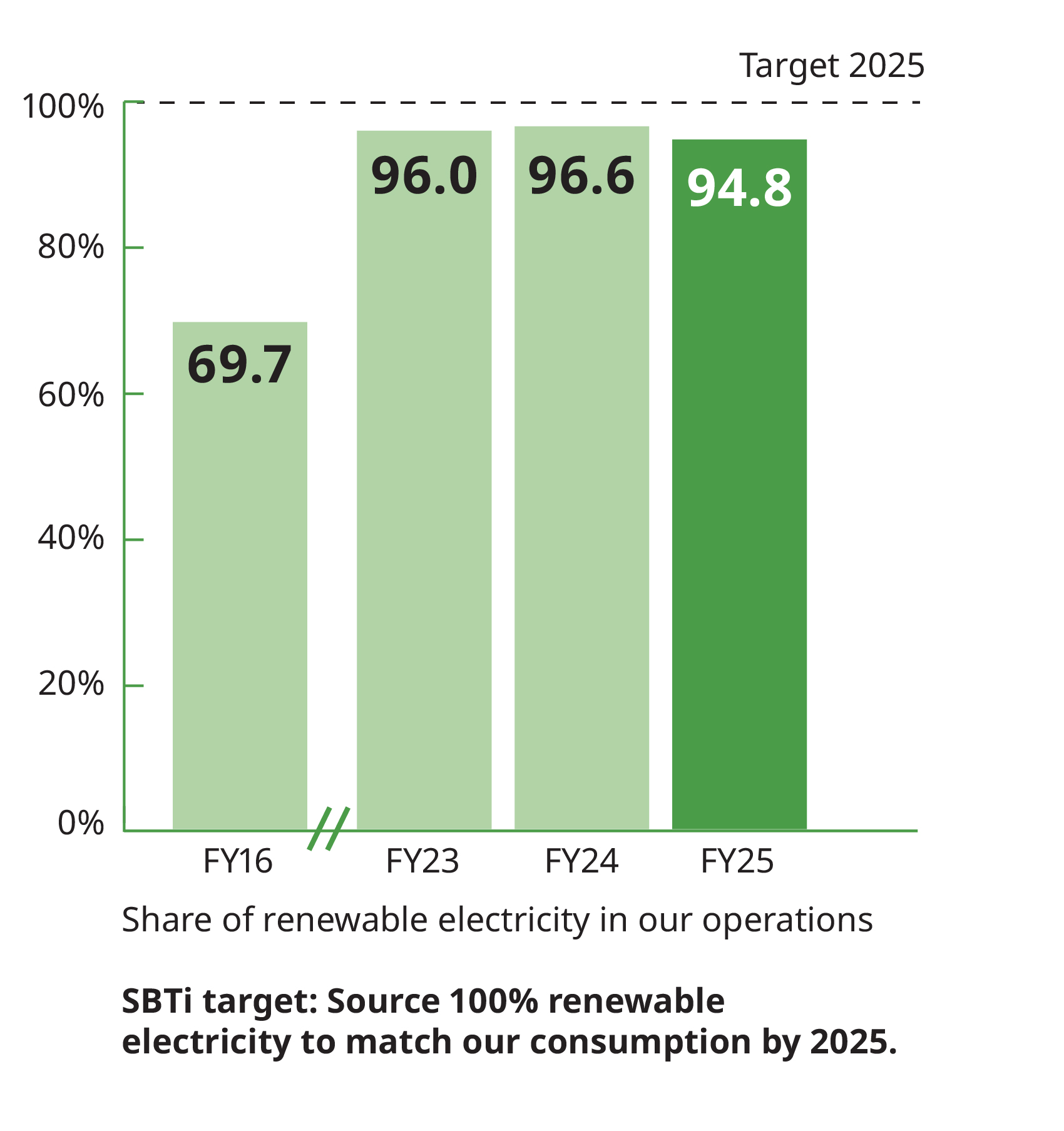
SBTi target: Source 100% renewable electricity to match consumption in our operations by 2025.
Needs improvement

Performance summary

In FY25, we sourced electricity from renewable sources to match 94.8% of electricity used in our operations (FY24: 96.6%, FY16: 69.7%). We strengthened our methodology and now only include Energy Attribute Certificates that comply with the updated RE100 technical criteria.This ensures our renewable electricity purchasing continues to meet best practice standards. However, it has resulted in a small decrease in the percentage of electricity from renewable sources compared with FY24 since not all existing suppliers were able to demonstrate compliance with the updated requirements. We are proud of the significant increase we have achieved since FY16 and have committed to continue sourcing renewable electricity to match our annual consumption up to 2030. In FY25, IKEA stores and Ingka Centres meeting places in 25 countries sourced 100% renewable electricity (backed by renewable energy attribute certificates). 

3.
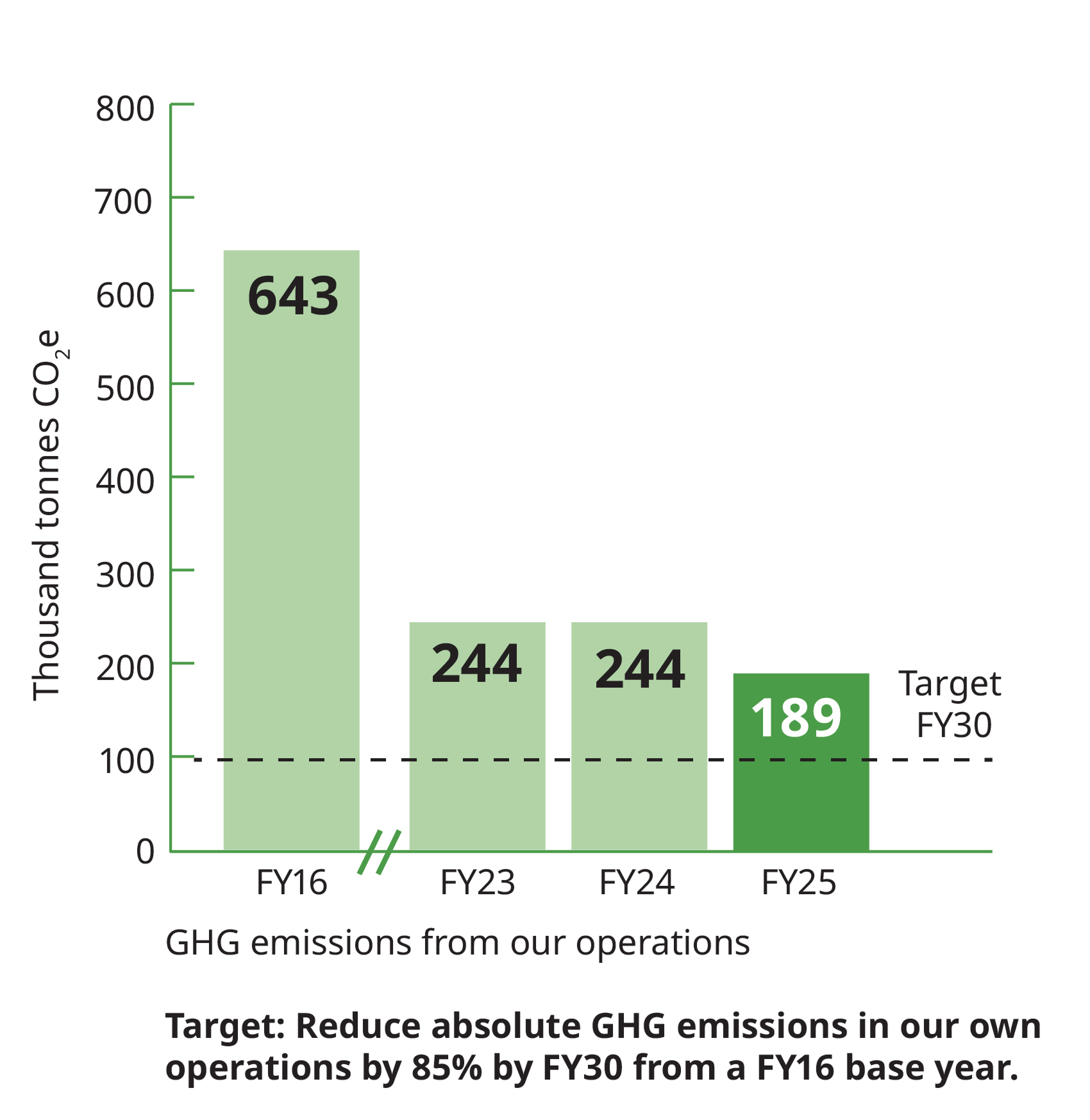
Reduce absolute GHG emissions in our operations by 85% by FY30 from a FY16 base year.
On track

Performance summary

We have reduced emissions from our operations by 70.6% since FY16. The most significant contributors to this reduction are our increase in sourcing of renewable electricity, improvements to energy efficiency in our buildings, use of biogas and installation of renewable heating and cooling systems. The closure of our retail business in Russia accounts for 13.2% of this reduction. 

Our operational emissions category includes scope 1 and 2 emissions as well as scope 3 emissions closely connected to our operations (scope 3 categories 3, 5, 8 and 13). The scope of our operational emissions reduction target is therefore broader than our SBTi approved target for scope 1 and 2 emissions (which is not included here). Our retail stores in Russia were closed in mid-2022, however, this change in our business did not result in an adjustment to our FY16 baseline. 

4.
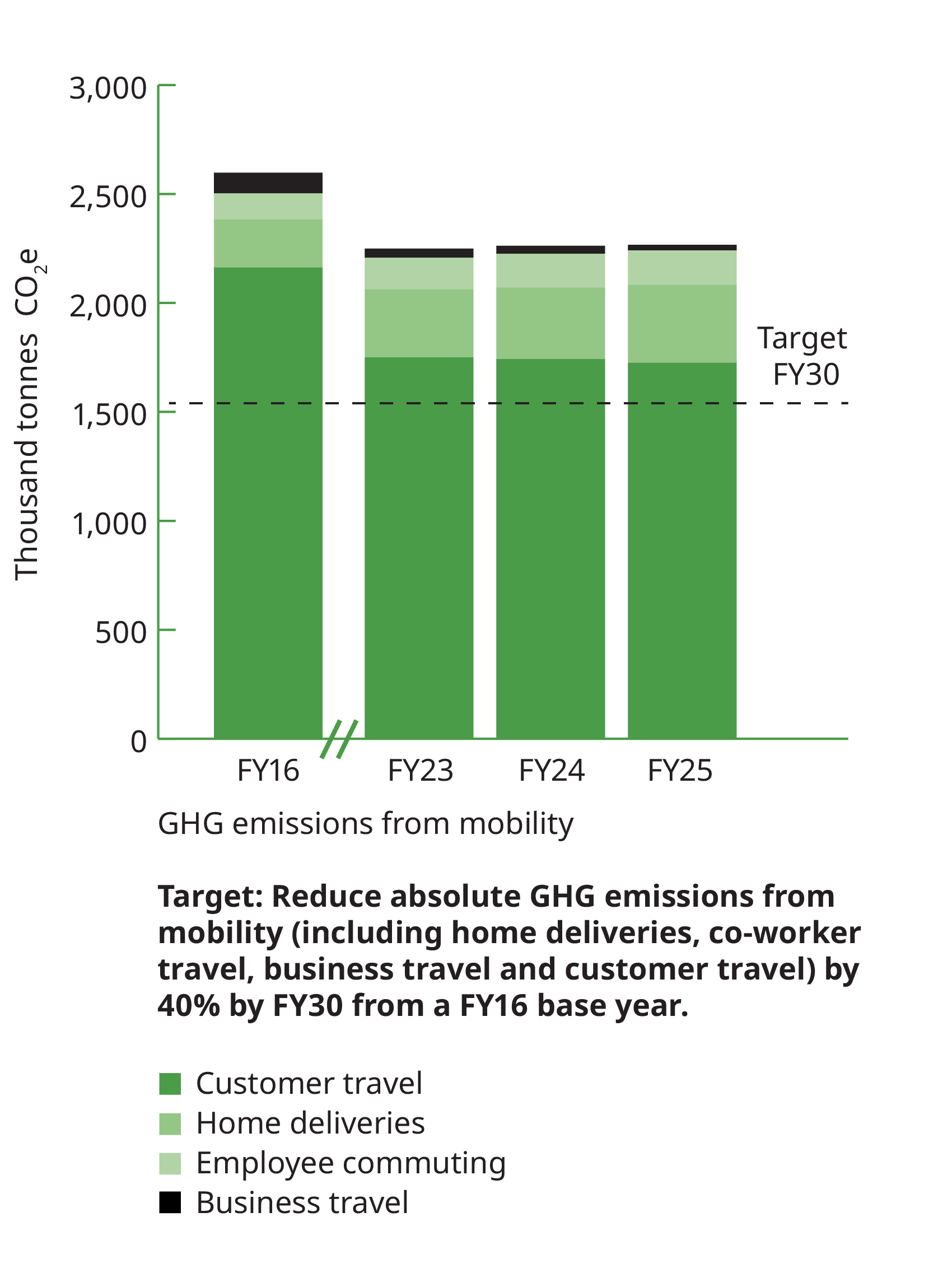
Reduce absolute GHG emissions from mobility (including home delivery, co-worker travel, business travel and customer travel) by 40% by FY30 from a FY16 base year.
On track

Performance summary

Emissions from mobility have reduced by 12.8% since FY16. The most significant reductions have been in customer travel and business travel. This reflects increased use of electric vehicles by customers, co-workers and our home delivery partners as well as more customers shopping online and reduced average travel distances for customers. The closure of our retail business in Russia has also had an impact. We are not yet able to fully reflect the impact of using renewable electricity to charge zero emission vehicles. This means our reported emissions are likely to be overstated. We are working to update our methodology to better reflect this.

This target includes our Optional SBTi approved target to reduce optional absolute scope 3 GHG emissions from downstream transportation and distribution from customer travel 40% by FY30 from a FY16 base year.

5.
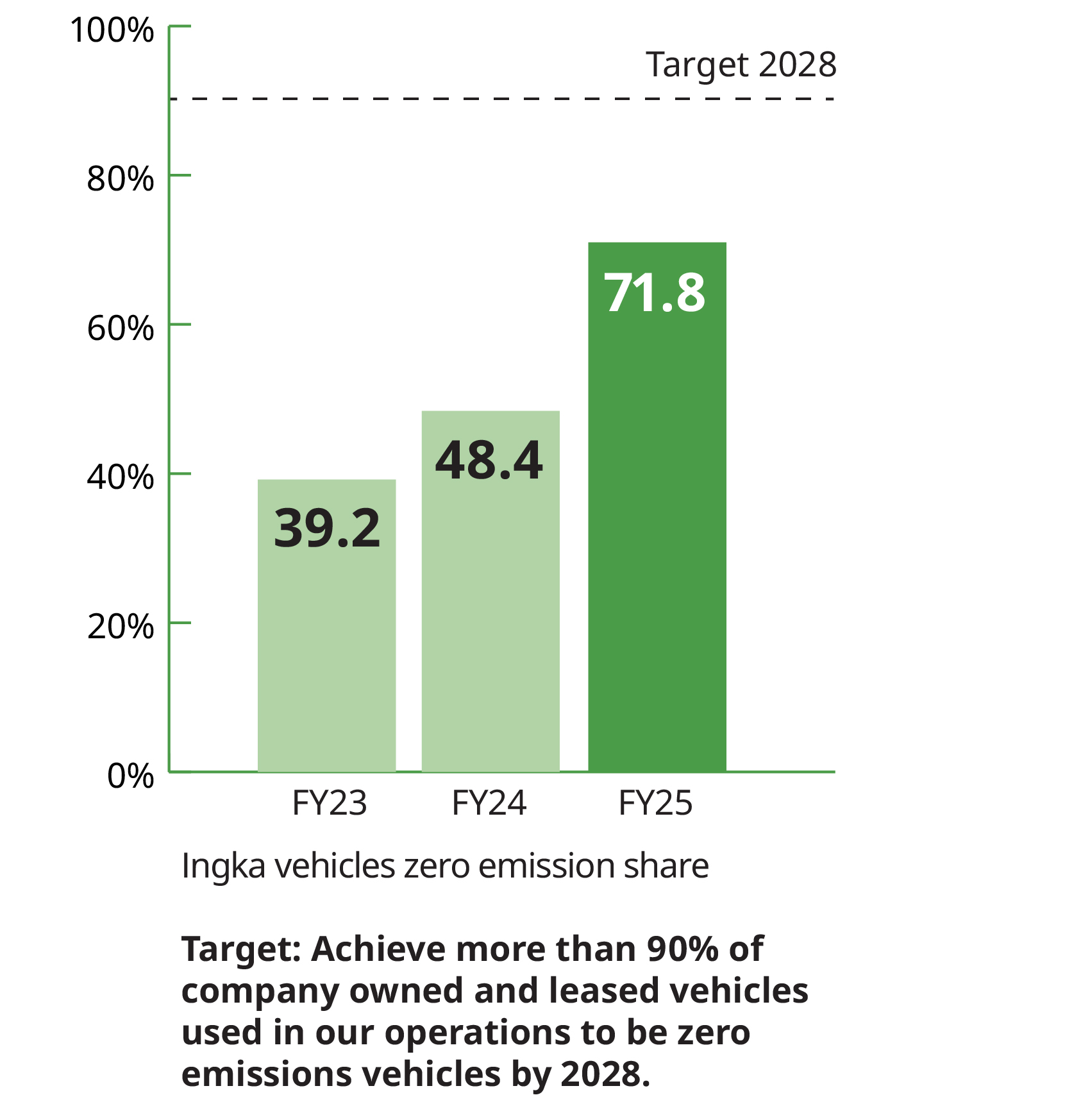
Achieve more than 90% of company-owned and -leased vehicles used in our operations to be zero-emissions vehicles by 2028.
On track

Performance summary

71.8% of company-owned and leased vehicles used in our operations were zero emissions vehicles, a significant increase on the previous year (FY24: 48.4%). We require all new owned or leased vehicles used in our operations to be zero emissions, wherever feasible.

ASSR graph CLIMATE Ingka vehicles zero emission share
6.
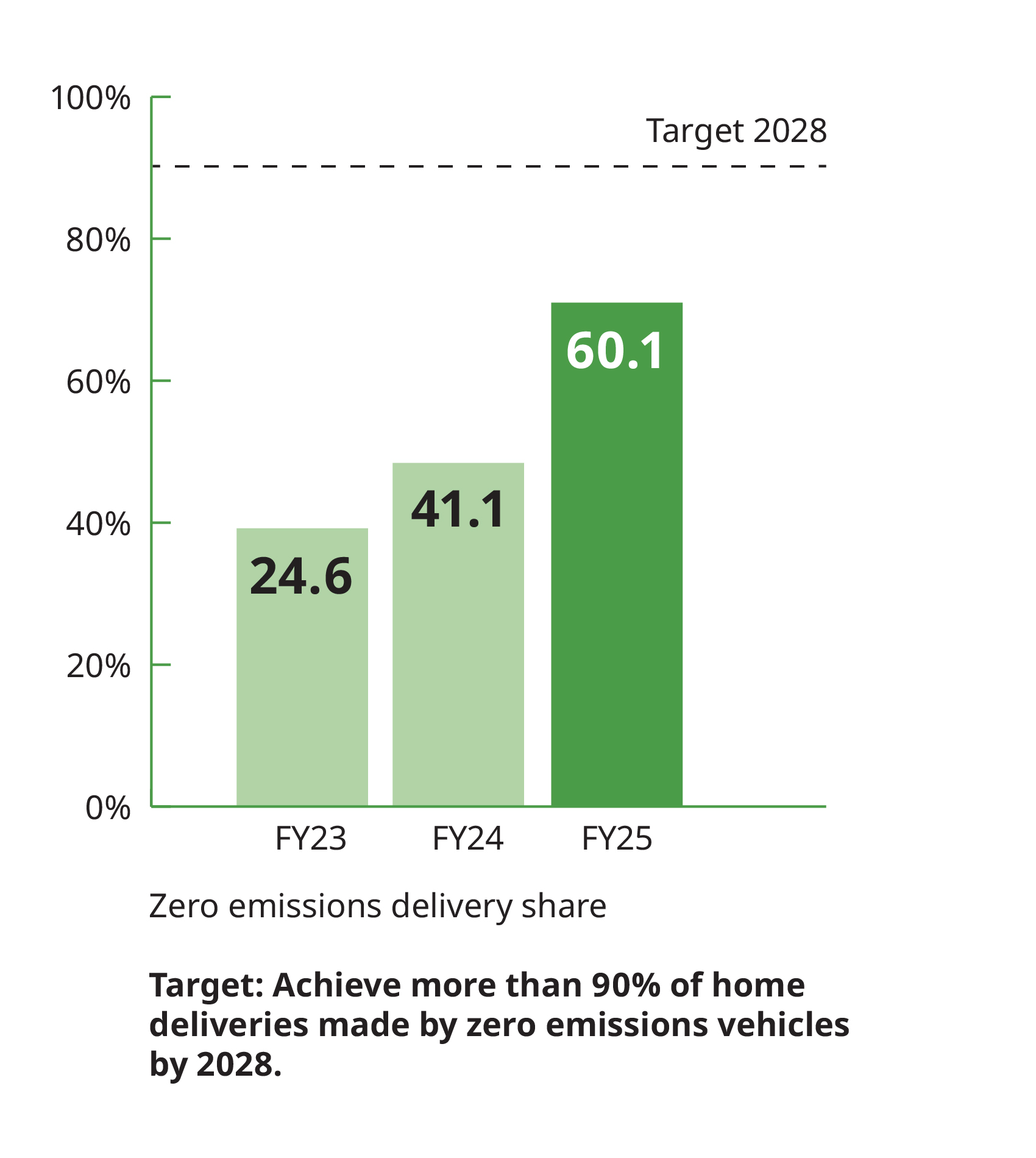
Achieve more than 90% of home deliveries made by zero-emissions vehicles by 2028.
On track

Performance summary

At the end of FY25, 60.1% of retail home deliveries were made by zero emission vehicles (FY24: 41.1%). This reflects an increase in the number of zero emissions vehicles used in last mile deliveries, investment in zero emissions trucks for longer distances and improvements in route efficiency to enable more deliveries per journey.

Despite this progress, absolute emissions from home delivery have increased by 61.4% since FY16 and 8.9% since FY24 due to continued significant growth in online shopping.


Bar chart showing the share of zero-emissions home deliveries increasing from 24.6% in FY23 to 60.1% in FY25, progressing toward a 90% target by 2028.
7.
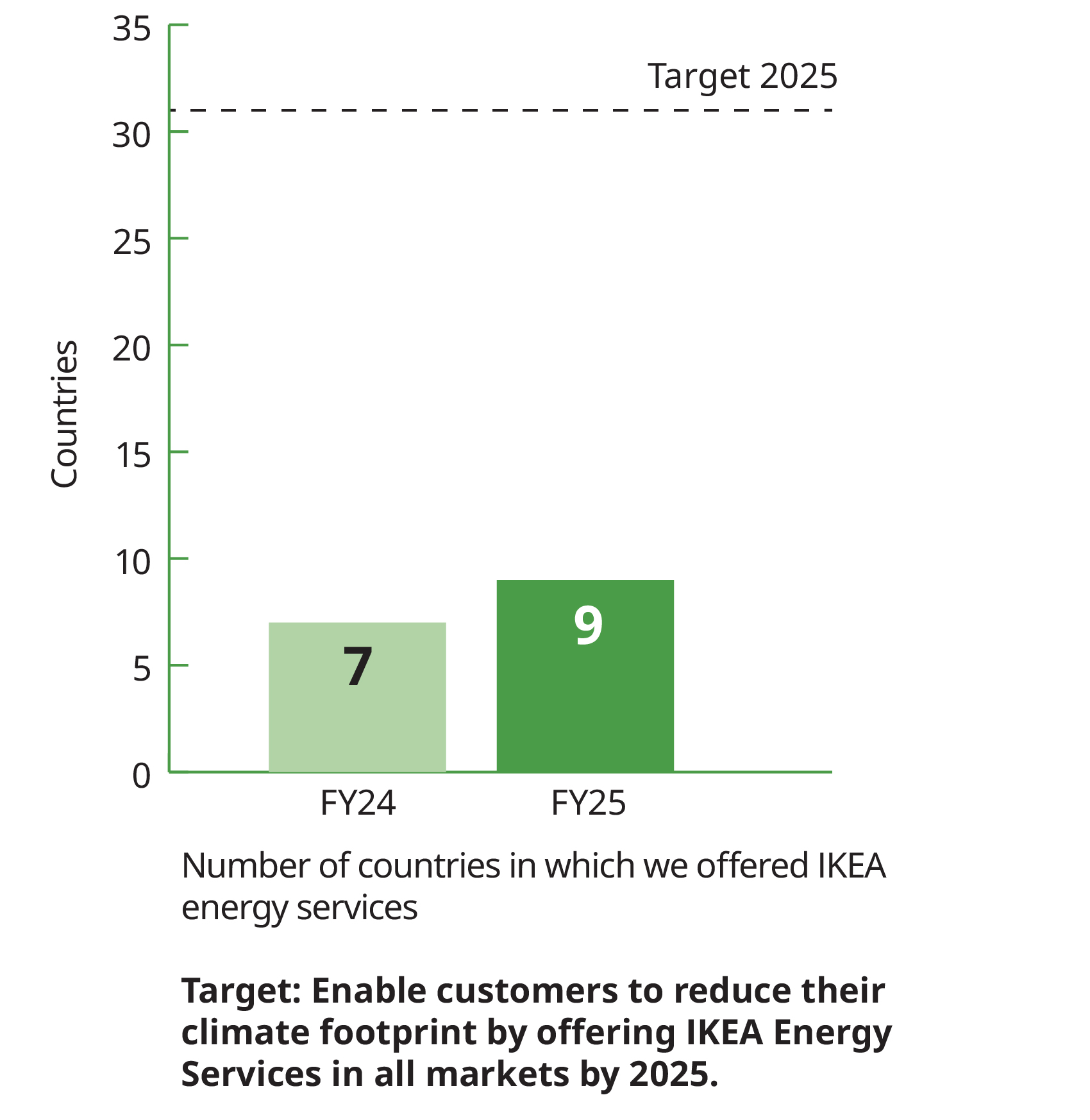
Enable customers to reduce their climate footprint by offering IKEA Energy services in all markets by 2025.
Off track

Performance summary

We offered IKEA energy services to help customers use and produce renewable energy at home in 9 countries (FY24:7 countries). We were disappointed not to meet our target. Expanding these services has proved challenging due to multiple and fluctuating factors that have made services less affordable for customers. Our target concludes in FY25, however, we will continue to support and develop our IKEA Energy Services in existing markets and expand into new markets where there is a strong business case and favourable regulatory environment. In early FY26, for example, we launched new services in the UK.

Bar chart showing the number of countries offering IKEA Energy Services increasing from 7 in FY24 to 9 in FY25, progressing toward full market coverage by 2025.

Water

Water stress, when demand for quality freshwater exceeds supply, is increasing around the world. This can affect the health of ecosystems and communities and can also impact businesses. We aim to use water efficiently in our operations and work with Inter IKEA Group to help address water use in our value chain.

Targets under development, to be disclosed in FY26 report.

Biodiversity and forestry

Our business depends on nature and access to natural resources, yet around the world nature is in crisis, with biodiversity being lost at an unprecedented rate. We believe that businesses must act now and we want to play our part in global efforts to halt and reverse biodiversityand nature loss.

Targets under development.

Resource use and circularity

We aim to integrate circular principles into our business. In our operations, we strive to reduce and recycle waste. For customers, we are developing services and solutions that make it easier to reuse, repair and recycle our products. Beyond our business, we invest in companies developing innovative circular solutions.

1.
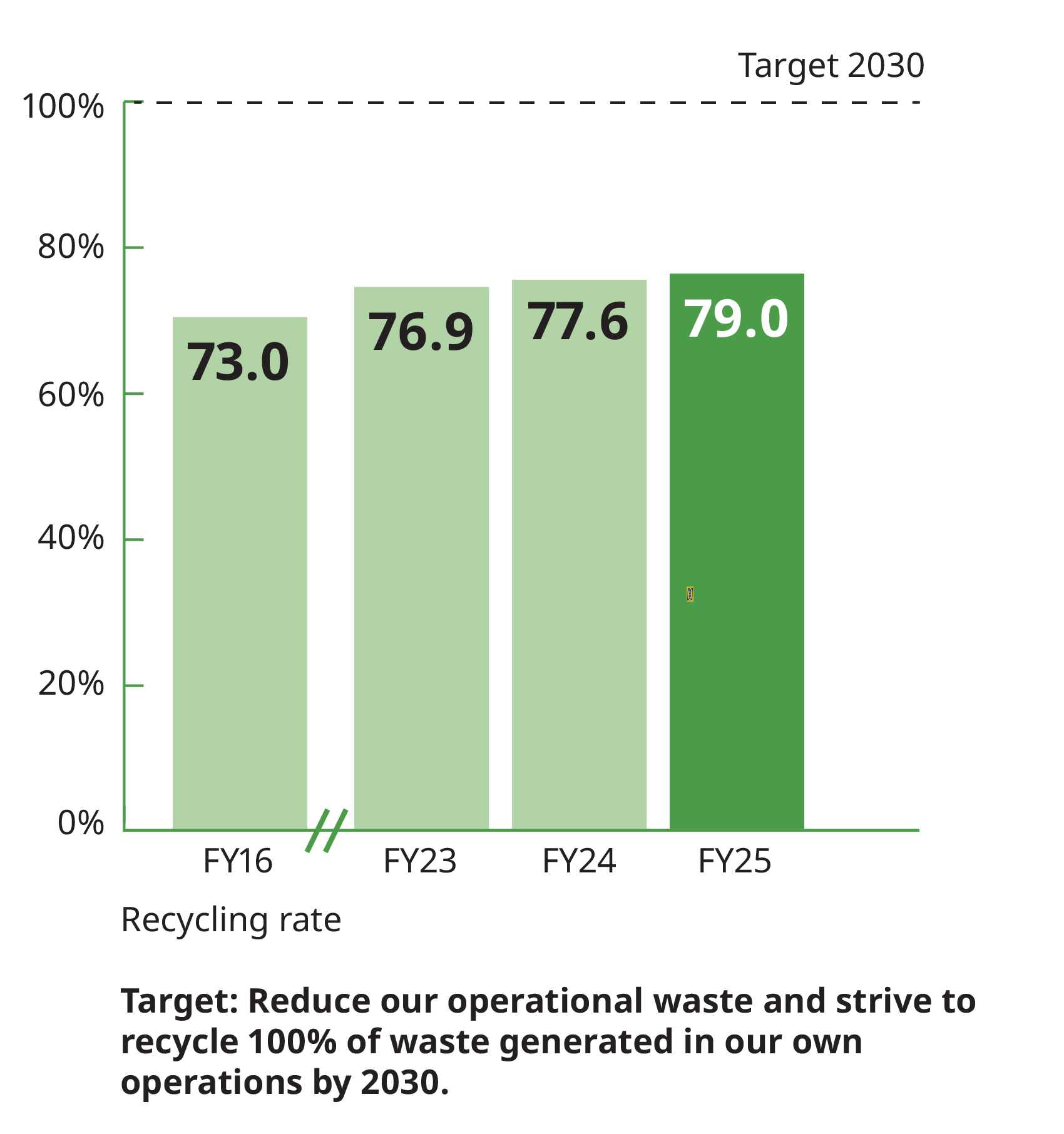
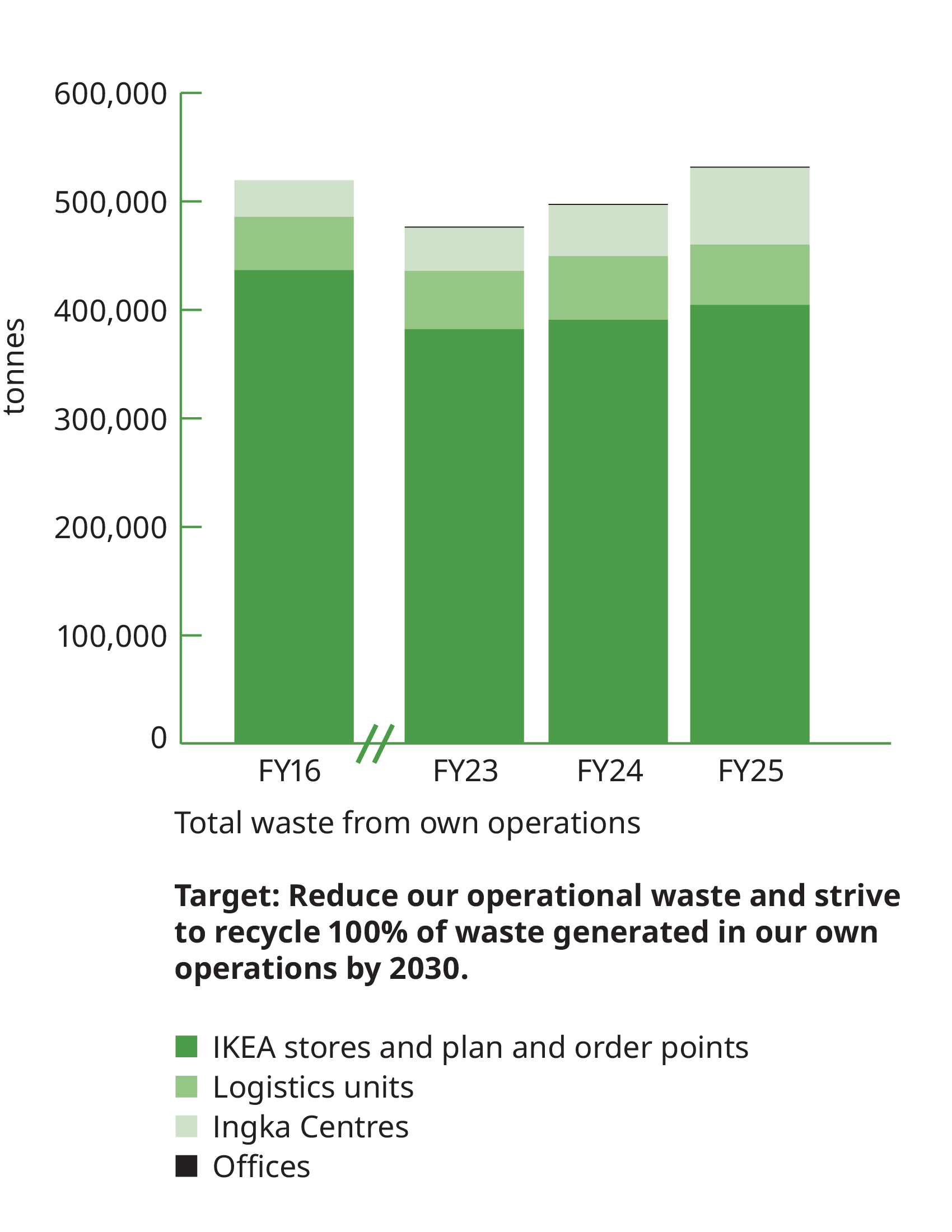
Reduce our operational waste and strive to recycle 100% of waste generated in our own operations by 2030.
Needs improvement

Performance summary

In FY25, we recycled 79.0% of waste (FY24: 77.9%). Our recycling rate varies significantly between countries and is influenced by factors such as availability of recycling infrastructure and local regulation. Total waste from our operations has increased by 6.9% compared with FY24 and by 2.4% since FY16. This increase reflects growth in our business, particularly the expansion of Ingka Centres since our baseline and compared with FY24 and the inclusion of more data on waste managed for tenants in some of our Ingka Centres meeting places. We remain committed to reducing waste and increasing recycling. Actions we are taking include working with tenants in our Ingka Centres to increase recycling and partnering with waste management providers to extend the types of waste recycled.  

Donut chart of waste disposal routes from own operations. Most waste is diverted from disposal by recycling (79.0%), followed by other recovery operations (14.0%). A smaller share, 6.9%, is directed to disposal through incineration, landfilling, or other disposal methods.

Further reading