
Reducing IKEA delivery emissions

The road ahead

At IKEA, we are working to reduce carbon emissions from deliveries as part of our broader efforts across the value chain. In every country, we are finding new ways to deliver to our customers. Using over 30 different localised solutions including electric cargo bikes in parts of Italy and Germany, boats on the river Seine in Paris, and electric three-wheelers across seven cities in India and Australia. We are working to more rapidly roll out electric or other zero tail pipe emission vehicles through additional investments in vehicles and charging infrastructure, piloting new innovations and collaborating with other industry players.

That is why IKEA is committed to halving emissions by 2030 and reaching net zero by 2050. We are also committed to the Paris Agreement and to helping limit global temperature rise to 1.5°C above pre-industrial levels. To get there, we’re taking a number of actions to reduce our greenhouse gas emissions. Accelerating the move to clean transportation is key to this.
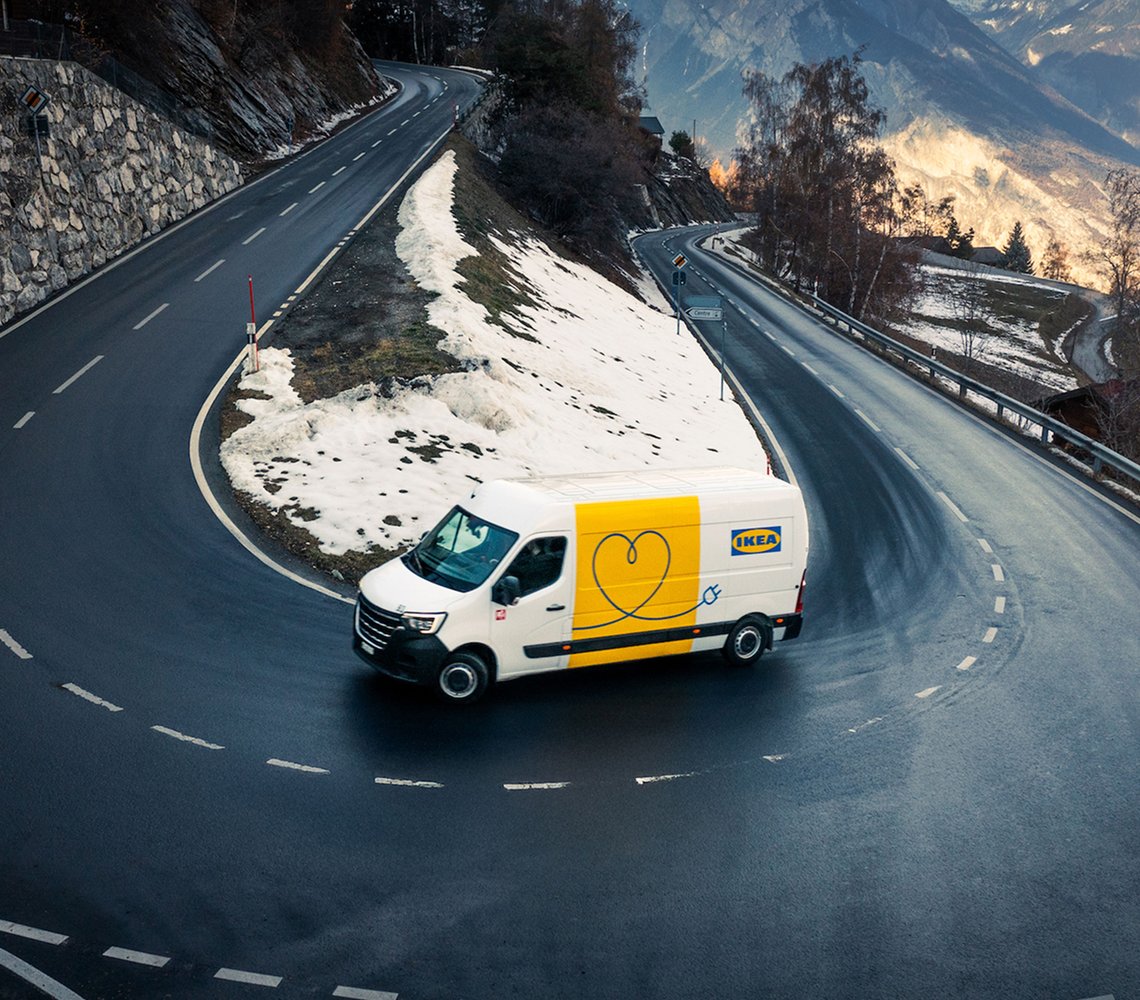
IKEA delivery van driving on a winding mountain road with snow patches and scenic valley views in the background.

Electric vehicle transition

Today, we deploy electric vehicles (EVs) for last mile home deliveries in 20 markets including China, Spain, France, India, the UK and many more. By the end of FY25, 60.1% of our retail home deliveries were made by electric or other zero-tailpipe-emission vehicles. Moreover, IKEA lent its design skills to Renault and MAN to help design the EV trucks we need in Paris and Berlin — optimising home deliveries and reducing the number of vehicles on the road at the same time. Already today, we offer EV charging at all stores where we offer parking in 31 markets.

Ingka Group is making significant progress globally towards electrifying our delivery fleet:

  • Already in 2019 Shanghai became the first city where 100% of our home deliveries are transported by electric vehicles and today we have 100% zero tail pipe emissions from home deliveries in +300 locations and more than 1500+ electric vehicles are in operation globally.
  • 60.1% of retail home deliveries were made by zero tail pipe emission vehicles (FY24: 41.1%). This reflects an increase in the number of zero tail pipe emission vehicles used in last mile deliveries, investment in zero tail pipe emission trucks for longer distances and improvements in route efficiency to enable more deliveries per journey.
  • We are working to more rapidly roll out zero emission vehicles through additional investments in vehicles and charging infrastructure, piloting new innovations and collaborating with other industry players. These actions include collaborating with truck manufacturers to test new EVs, investing in charging infrastructure, and advocating for policy changes to overcome regulatory barriers.

Our acceleration towards low carbon transport is a work in progress. Nevertheless, we hope that we inspire businesses, governments and policy makers to take ambitious climate action in this area.

Join us to rise to our greatest challenge

We encourage businesses to collaborate across sectors and drive action within initiatives like EV100, the WEF CEO Climate Leaders Alliance, the We Mean Business Coalition, the World Resource Institute and many others.

When it comes to governments, we support the key demands from the We Mean Business Coalition regarding transport. Specifically, we ask that governments and policy makers implement increasingly stringent emission standards for all road vehicles. That includes continuing to promote fuel efficiency and shifting from cars and trucks to low-emission transport modes. It also entails committing to 100 percent sales of electric and zero-tailpipe-emission vehicles by 2035 for new, light-duty vehicles. Finally, we support countries investing in infrastructure that would make EV charging reliable and seamless for all.

Climate change is our greatest challenge — and we are committed to playing our part.

Let’s assemble a better future.