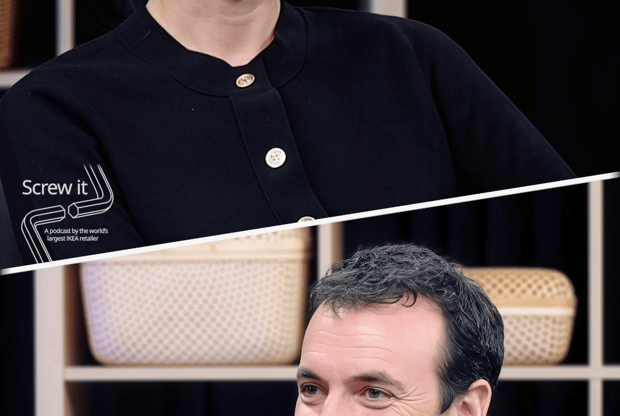
In this episode of Screw It, Raphael Guillard, who leads responsible sourcing for Ingka Group, talks about decarbonising logistics, social enterprises, and why none of it works if the business case doesn’t.
Oil prices have risen sharply this year. For most companies that run large delivery fleets, that means higher costs and difficult conversations with suppliers. For Ingka, which has spent the last six years moving its deliveries away from diesel, a growing share of those routes are insulated from fuel price rises.
In FY24, 60.1% of Ingka’s home deliveries were made with zero-emission vehicles. That looks different depending on where you are; electric cargo bikes in Italy and Germany, boats on the river Seine in Paris, electric three-wheelers across cities in India and Australia. Over 30 different local solutions in total. The target is to get above 90% by the end of 2028. The aim will always be to go beyond 90%, but the gap to 100% represents the uncertainty that will always remain when delivering to customers, such as geography in certain countries where we need to reach very remote areas, lack of chargers in remote locations, the growth of the business, possible vehicle breakdowns that require replacement by a non-EV vehicle at short notice to deliver our customers’ products as promised.
What nobody planned for was that this transition would also function as a hedge. Companies that decarbonised their logistics early are now insulated from the oil price shock squeezing everyone else. “From a pure business perspective you say: that was the right thing to do, to anticipate that we are no longer dependent on fossil fuel.“
Getting there has not been straightforward. When we started this journey, electric trucks were still a relatively new technology, charging infrastructure was not yet in place across all markets, costs were higher than traditional diesel delivery, and rolling out new solutions across 31 countries takes time. To overcome our challenges, we introduced a dedicated project implementation manager working on zero emissions home delivery in each of our retail countries to address local challenges, supported by a global team. Additionally, we invested in piloting new technology and established new charging infrastructure at our retail sites. Together with our partners, such as the Climate Group through EV100, we advocate for policy changes that will reduce barriers and enable a faster transition away from fossil fuel powered mobility, not just for IKEA, but for everyone.
It is the argument that sustainability investment is also risk management, and the oil market just made that case more plainly than any sustainability report could.
The same logic applies to social enterprises
Raphael’s background is in startups before IKEA, small companies where decisions were fast and consequences immediate. He describes those years as speedboats. IKEA, he says, is the cargo ship. His job now is working out how the cargo ship sources the services it needs in ways that also create genuine social impact.
The distinction he keeps making: this is not charity. Charity requires repeated donation. What he is trying to build are business models that work for the social enterprise, for Ingka, and for the customer. “How can we, together with a social enterprise, find a business idea that works for them, works for us, works for our customer?”
Paris: Carton Plan
The first test was in France. Ingka needed customer collection points in central Paris, but finding suitable space for bulky furniture in a dense city centre is not straightforward.
Through Yunus Social Business, a consultancy that helps companies work with social enterprises, they connected with Carton Plan, an organisation in Paris working with people experiencing homelessness. The connection was not obvious at first, but Carton Plan had space in the city centre and Ingka needed it.
Carton Plan expanded their team to manage the new activity and trained people to run a customer-facing service. A pilot ran connected to one store, and customers could walk, cycle or drive to collect orders.
Switzerland: BAND and VEBO
The most recent initiative is the first live result of the Social Enterprise Partnership (SEP) Programme, developed jointly by Ingka Group, IKEA Social Entrepreneurship, and Yunus Social Innovation.
The business problem was kitchen installation. IKEA Switzerland was selling more kitchens than it had capacity to install, with customers waiting a month or more. The SEP Programme scanned the market, assessed ten social enterprise candidates, ran a pitch day, and contracted two: BAND and VEBO, both working with people with disabilities. Each job is carried out by one specialist carpenter paired with one person with a disability who supports them through the installation. The quality is the same as with any traditional partner, but capacity has increased and lead times have come down.
What stops other companies
Large purchasing organisations look for large suppliers. Social enterprises are typically small, take longer to onboard, and do not always fit standard procurement processes. Raphael’s view is that without specialist help to find and vet candidates, most companies simply will not look in that direction. Yunus and their local networks reduce that friction significantly.
His advice to other large organisations: start small, but plan for scale from the beginning. “Every person that we support is a small victory. But if we are a big corporation, we need to scale it up.”
Screw It is a podcast from Ingka Group. New episodes are available on Spotify.
About the Podcast
Screw It is a podcast from Ingka Group, the largest IKEA retailer, exploring the “art of assembly” in business, sustainability, and life at home. The series invites global experts and leaders to discuss how we piece together better homes and societies, even when life looks nothing like the manual. From a company that wants people to sit comfortably, but recognises that progress is often uncomfortable, Screw It ditches the corporate script to embrace the “wonderful mess” of building a better future.
About Ingka Group
With IKEA retail operations in 31 markets, Ingka Group is the largest IKEA retailer and represents 87% of IKEA retail sales. It is a strategic partner to develop and innovate the IKEA business and help define common IKEA strategies. Ingka Group owns and operates IKEA sales channels under franchise agreements with Inter IKEA Systems B.V. It has three business areas: IKEA Retail, Ingka Investments and Ingka Centres. Read more on Ingka.com.
Screw It – Episode 7 – Full Conversation Transcript
Kat: Raphael, thank you so much for joining me.
Raphael: Thank you.
Kat: Do you mind just telling me a little bit, how did you get here? What is your background?
Raphael: I am in charge of responsible sourcing in IKEA, the logistics and transport part. My background is fifteen years in IKEA, but with a life before that. Starting around 2000 in a startup, that was just when startups were getting going, retailing fitness equipment online for a very small company that grew quite fast. First employee; after four years, maybe more than a hundred. Then moving to another startup, retailing design furniture online across Europe. Another four years, start small, get bigger. Managing purchasing, logistics.
Kat: Is that how you got into logistics?
Raphael: That is how it started. I actually studied purchasing at school, so there is a thread throughout. Purchasing, then the startups, and then after eight years in those speedboats I found this IKEA cargo ship. Much bigger, of course. But many good things there too. Starting in purchasing again, working in France, then Spain, Portugal, Italy, then six or seven years ago joining Ingka Group here in Sweden.
Kat: What is the biggest difference between working for a global organisation and a local one?
Raphael: Speed, maybe. And more structure, always pros and cons. In a startup you decide something one day, you start implementing a week later, and then you find out if it works or it does not, and then you start again. In a big corporation: much more process. Still good, it is structured. But it takes a bit more time to see what you want to implement actually being implemented.
Kat: Because what you are doing right now requires a lot of innovation, essentially.
Raphael: It is a mix between purchasing, procurement or sourcing, almost the same words, and sustainability. Responsible sourcing, which in other companies they might call sustainable procurement. This means ensuring that whatever we purchase makes a positive environmental impact, social impact, that we have a code of conduct with our suppliers, that we can audit them, and that at the end of the day we can do good business. But respecting those three criteria: social, environmental, ethics.
Kat: Within that area, the most recent example is what launched in Switzerland. Do you want to tell me a little bit about that?
Raphael: This is talking about social enterprises. Maybe we need to start by explaining what a social enterprise actually is. Ingka is not a social enterprise, we also want to make positive social impact, but it is different. A social entrepreneur is someone setting up a business where the primary aim is to make a positive social impact or tackle social challenges. Usually what we say is these companies put purpose before profit. And that is important. It does not mean profit does not matter, you cannot just burn money. But first they want to do something good for people or the planet. They have a business idea, they generate revenue, and they reinvest that revenue into making better impact. Usually they want to support vulnerable people. And when it works, they can grow, employ more people, support more people. Ingka is not a social enterprise, but we work with them.
Kat: Because you and I worked together back in the day, and I think back then it was quite new.
Raphael: New for us in this function. Not totally new for IKEA, we have been working with social enterprises for years. But when we worked together, that was just the start of saying: okay, now let us make it happen in our function too. In logistics and transport, customer fulfillment, last-mile deliveries. We have an opportunity. We teamed up with a consultancy company called Yunus Social Business, and that was a real eye-opener.
Kat: What did they support you with? How does working with them actually look?
Raphael: They are a consultancy specialised in supporting companies to work with social enterprises. They came in and that was the exploration phase. We were a group of maybe ten to fifteen people, and they put the finish line on the table: making social impact. Then we explored what business models could apply to our scope, that would still meet a business need we had, but also bring positive social impact. And that is actually the beauty of this topic: it is not about charity. Charity you do once, and then you need to do it again every time. This is more: how can we, together with a social enterprise, find a business idea that works for them, works for us, works for our customer? That was the two-day workshop. I thought we would not have many ideas. We had maybe a hundred. Then Yunus helps you focus on what is actually realistic.
Kat: What were some of the ideas?
Raphael: So many ideas now, hard to remember them all. But we tested two. One is still live in France. We teamed up with a social enterprise working with homeless people in Paris, an organisation called Carton Plan. They were already involved in collecting and recycling cardboard. No obvious connection to IKEA. But they had space in central Paris. And through our omnichannel journey, we needed collection points for customers in the city centre, finding space for IKEA furniture in central Paris is genuinely not easy. So they had space and people, and we had the need. Yunus facilitated the connection. We piloted it connected to one store, routing some customer orders to this collection point. Carton Plan expanded their team, trained more people in how to manage the activity. Customers could walk, cycle, or drive to collect. What was also significant was what the work meant to the people doing it. Usually if you are homeless, the way others look at you is different. Something shifted, they were giving a service to customers. It helped them to be more self-confident. That is the definition of responsible sourcing: it makes a social impact, it is good for IKEA because it is a new service, and it is good for the customers.
Kat: It is almost like you had the solution before you even matched it to the problem.
Raphael: We had a list of problems we wanted to solve, and ideas that matched with a list of problems that associations also wanted to solve. When you find the match and it is good for everybody, that is when you say: okay, this is sustainable. This is not charity. It is finding a business model that works. And the good thing with a business model that works is that you can scale it up. If it is a win-win-win, you have found the recipe. And doing more is better for IKEA, better for the vulnerable people, better for the customers.
Kat: What are the other elements of responsible sourcing beyond the social?
Raphael: We also try to purchase services that respect the planet. In our scope, we know we have an impact. We deliver to over twenty million customers every year in 31 countries, and historically we have done it with diesel trucks. CO2 emissions, traffic congestion, we know the impact. And knowing that means asking: what can we do better? How can we still deliver to our customers but impact the planet a little less?
Kat: How do you convince the business to get on board? At the end of the day, it is a new concept.
Raphael: It is not a natural move for most companies to switch to electric deliveries. First, it always helps to be supported by a company strategy where it is written somewhere that the long-term ambition is to switch. You can always rely on something built by your CEO. It helps, but it is still on paper. Then you need to make it happen. You go to the country, you explain why, you explain the potential, and you start, slow and low. With last-mile delivery transitioning to zero emission, we had pushback from almost all our countries. Maybe one or two early adopters. The pushback? It will not work. We do not have the right trucks, and maybe they did not exist yet six years ago. We need charging infrastructure. And at the end of the day: it costs more. We are a purchasing function. We are not here to increase costs. And if on top of that I come and tell you to decrease costs while switching to something that costs more, that is pushback. So first we had to explain how to mitigate those costs, and then we had to test. We asked every country to invest in one electric truck and start using it. That was the start. In many countries it just proved how it actually works. Maybe it costs a little more, but less than people thought, because we invested time in finding the right business model.
Kat: What has been the biggest challenge and the key learnings?
Raphael: The biggest challenge was the dual ambition: decrease costs, but switch to something that costs more. We built a small project team here in group, and we bet on recruiting one specialist per country. The bet was: investing in people will cost a little, but will avoid paying much more for the transition. It proved to be right. Two or three months ago we were almost break-even, which is really good. And then with what has happened in the world, the oil price going up significantly, nearly two thirds of our twenty million deliveries are now zero-emission, so we are almost non-impacted for those. It is not good what is happening in the world. But from a pure business perspective: that was the right thing to do, to anticipate no longer being dependent on fossil fuel.
Kat: And the latest initiative, Switzerland.
Raphael: The latest initiative is working with social enterprises, and this time it is social impact, not environmental. The start is similar: what is the business need? In Switzerland, it was kitchen installation. IKEA sells a lot of kitchens. I cannot install one, and I am guessing you cannot either. We outsource this service in 31 countries. In Switzerland, they were selling a lot of kitchens but missing service capacity, more demand than supply, affecting sales. Wait times of up to a month. So that was the business need. We worked through the SEP Programme, the Social Enterprise Partnership Programme, developed jointly by Ingka Group, IKEA Social Entrepreneurship, and Yunus Social Innovation. They scanned Switzerland for social enterprises that could provide installation services. Ten candidates were assessed. We ran a pitch day. And we ended up contracting two: BAND and VEBO, both working with people with disabilities. The model pairs one specialist carpenter with one person with a disability who supports them. Same quality as with any traditional partner. Lead time has fallen. And two organisations whose purpose is employment for people who struggle to access it now have Ingka as a commercial partner.
Kat: What happens next?
Raphael: Push or pull. Push means we set a goal, every country in our scope needs to contract with at least one social partner by end of the year and try something. Same approach as the one electric truck: start with one, see that it works, then scale. Pull means we come with a support package and let countries take it if they want to, though we are influencing quite a bit that they do.
Kat: Is there appetite?
Raphael: We already have social enterprises in France, Italy, and now Switzerland. Belgium is next. There is a queue. Countries apply to the programme, we validate the request, and it comes with support. A consultancy helps identify the business need and connects with local social enterprise networks. They cover North America, Europe, Asia Pacific, 31 countries. When the business model works, the country rolls it out.
Kat: I was reading there are around 4.3 million social economy organisations in Europe, employing I think 11.5 million people. I will have to double check that. What do you think stops organisations from partnering with them?
Raphael: I cannot speak for everyone. But I think it is about being the big cargo ship. When you are in a large purchasing organisation with big needs, the first thing you do is look at the biggest suppliers. Social enterprises are SMEs, often very small. Onboarding them takes time. There is not always a natural fit with structured corporate processes. So if you do not want to invest that extra time, you naturally do not go there first. And you need to know they exist, because they are small. That is where specialist support matters.
Kat: Someone mentioned these organisations are actually really agile and fast, as opposed to the big boat we are on.
Raphael: They can help large organisations to be more agile. It is always good to bring outside perspective in. In a big corporation, people have often been there a long time, it is good to inject new blood. Meetings with social enterprises are refreshing. They really want to make things happen and do it fast. They are often the ones pushing us to accelerate the process.
Kat: Final question. What would you say to other organisations the size of IKEA considering this?
Raphael: I think half the work is already done if you are asking the question. Dare to try. Start low, start small. Be ready to invest a bit more time than you would with traditional suppliers. And think big from the beginning, otherwise it will always stay small. Every person we support is a small victory. But if we are a big corporation, we need to scale it. Start, dare to try, see how it works. And usually it does. It is also good to give to charity, of course. But this is not about that. Responsible sourcing is about doing something that is good for the company, good for social and environmental impact, good for our customers. Once you have that, it will work.
Kat: Raphael, it has been great talking to you. Thank you so much for joining me.
Raphael: Thank you very much.
Media enquiries
For further information, journalists and media professionals can contact us at [email protected] or by calling +46 70 993 6376.