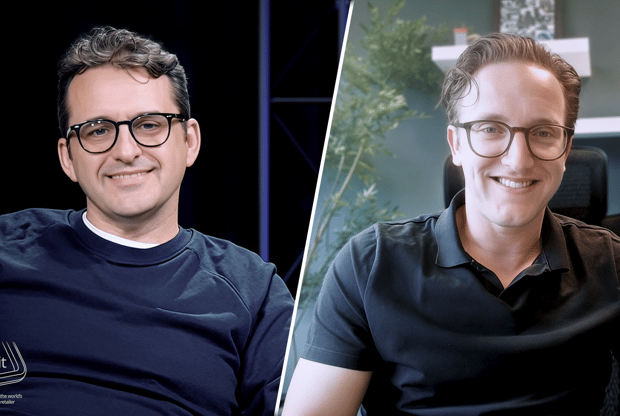
Most of us spend around a third of our lives on a mattress. But what happens when it’s time for a new one? For decades, the answer was mattresses were sent to landfill or incineration. Today, that answer is starting to change. In the latest episode of Screw It, Ingka Group’s podcast exploring the ideas helping create a more circular future, we meet Chico van Hemert, Managing Director at RetourMatras, a company that’s proving that an old mattress can be much more than waste.
A big challenge hiding in plain sight
Every year, around 40 million mattresses reach the end of their life in Europe. They’re bulky, difficult to transport and surprisingly complex to recycle.
“The founder of RetourMatras saw an opportunity where others saw waste,” says van Hemert. “He believed valuable materials should not be burned or buried when they can be used again.”
This idea helped launch one of Europe’s largest mattress recycling businesses. What started as a bold vision has since grown into an operation that recycles around 2 million mattresses each year.
What if waste was actually a resource?
Inside a mattress you’ll find steel, textiles and large amounts of foam. In the episode, van Hemert explains how with the right technology and process, these materials can be recovered and given a new life.
One of RetourMatras’ biggest breakthroughs has been finding a way to transform recovered mattress foam into recycled polyol, a key ingredient used to make new foam.
In other words: yesterday’s mattress can help become tomorrow’s new mattress. That’s what circularity looks like in practice. Put simply, circularity means keeping products and materials in use for as long as possible, rather than making, using and throwing them away. In the case of a mattress, that means recovering its materials at the end of its life and finding ways to use them again in new products.
The future of recycling starts before a product is made
Recycling is important. But designing products for their next life may be even more powerful.
For van Hemert, one of the biggest opportunities lies in making products easier to dismantle and repair from the very beginning.
Think fewer mixed materials. Less complex construction. More opportunities to replace a single component instead of an entire product.
It’s a shift that could make life easier for recyclers, manufacturers and customers alike.
Circularity is a team sport
No single company can create a circular economy alone.
Throughout the episode, van Hemert talks about the importance of bringing together recyclers, product designers, policymakers and businesses to help materials stay in use for longer.
This includes ongoing collaboration with IKEA teams to explore everything from product design and recyclability to how recycled materials can find their way back into the value chain.
Small actions. Big impact.
The next time you replace a mattress, van Hemert has one simple request: make sure it is recycled.
It may seem like a small action, but it’s an important step in helping valuable materials stay in circulation and reducing waste.
Because when we start seeing old products as future resources, new possibilities begin to open up.
Listen to the latest episode of Screw It to hear how RetourMatras is helping turn yesterday’s mattresses into tomorrow’s materials, and why the future of circularity may start in the place we least expect: under our sheets.
Screw It – Episode 15 – Full Conversation Transcript
Paul: Welcome to Screw It. What if recycling mattresses was not just about reducing waste, but about rethinking entire industries? Today, I’m joined by Chico van Hemert of RetourMatras. Enjoy the episode!
Paul: Welcome, Chico, to the podcast. Let’s start with RetourMatras as a company. It’s been credited with inventing mattress recycling back in 2009. What was mattress recycling like back then? What did the company actually start doing? Can you give me a little history of the company?
Chico: Thank you for the invitation. First of all, I’m honored to be on the podcast.
In 2009, I wasn’t involved in the company yet, but I met the founder three years later. He explained how it all started and what they had achieved up to that point.
Back in 2009, they saw an opportunity to recover materials from mattresses that were ending up in municipal bulky waste streams. The founder strongly believed that raw materials would become scarce in the future, so it would be better to reuse them rather than incinerate or landfill them.
He already had experience in recycling. He had worked in gypsum recycling and furniture recycling, and he was constantly developing new recycling methods. Mattress recycling became one of those opportunities when he felt the market was ready for it.
However, it took quite some time to turn it into a successful business. In 2009, mattresses were not collected separately from bulky waste. They were mixed with many different materials and often contaminated, which made recycling very difficult.
Another challenge was the lack of machinery. There were no machines available to dismantle mattresses, so we had to develop our own technology. Over the years, we focused on making the process more efficient because, ultimately, you have to compete with the costs of incineration and landfill.
At the same time, you need markets for the materials you recover. Without companies that can use those recovered materials, recycling doesn’t really exist.
Paul: You joined the company as a student, and now you’re leading part of the international expansion. The business has grown significantly over the last few years. What was it about the company that made you want to stay? What inspired you to continue building your career there?
Chico: There were two main reasons.
First, I saw the founder as a very successful entrepreneur. He had already built several companies, and I knew I could learn a lot from him about entrepreneurship, business growth and leadership.
Second, I strongly believed mattress recycling was still in its early stages, even in the Netherlands. I saw a huge opportunity to grow the business while also having a positive impact on the environment.
Paul: The founder firmly believed that burning mattresses was the wrong approach. Incineration was the norm at the time, wasn’t it? Around 40 million mattresses are discarded each year in Europe. He was very much against incinerating them, correct?
Chico: That’s correct.
He believed incineration was the wrong option because the materials can be reused. There is also the issue of CO₂ emissions. He understood how waste management companies operated and recognised that valuable raw materials were being lost through incineration.
By recovering and reusing those materials, they can be put back into products in a much more efficient way. At the same time, incineration facilities can use waste streams that are actually better suited for energy recovery.
Paul: Can you talk me through why it’s important to recycle mattresses today? And why is it so difficult? What makes mattress recycling so challenging?
Chico: It starts with collection. A mattress is a very bulky product, but it doesn’t weigh very much because it isn’t very dense. As a result, collection and transport are relatively expensive compared with other waste streams.
That was one of the first challenges we faced. We spent years advocating for mattresses to be collected separately from other waste streams, but that creates additional costs.
Another challenge is dismantling. Today, we’re recycling mattresses that were produced roughly ten years ago. At that time, manufacturers weren’t thinking about how those products would be dismantled or recycled at the end of their life. Materials were glued together or stitched together, which makes them much harder to separate.
Fortunately, that’s starting to change. We’re now working closely with companies like IKEA and their product development teams to make future mattresses easier to dismantle and recycle. The challenge is that we’ll only see the benefit of those improvements many years from now because mattresses have a long lifespan.
Paul: What’s actually inside a mattress when you break it down? And have you ever found anything unusual over the years?
Chico: That’s a funny question. Yes, we’ve found jewellery and money inside mattresses.
In terms of materials, the main component is polyurethane foam. Besides that, you’ll find metals, textiles and a smaller residual waste fraction.
The foam itself is made using chemicals. As I mentioned, we’re recycling products that were made around ten years ago, so sometimes they contain substances that are no longer allowed in products today. We call these chemical legacies. That creates an additional challenge for recyclers because manufacturers working with virgin materials know exactly what they’re using. We have to deal with materials from the past.
That said, we’ve developed solutions over time, and I’m confident that the materials we recover can be reused safely.
Paul: My understanding is that you currently recover around 80 to 85 percent of each mattress. What makes up the remaining percentage that can’t be recycled?
Chico: That remaining 15 to 20 percent is the most difficult fraction.
Recycling works best when you have clean, separated material streams. For example, if textiles are separated from metals, each material can go to the appropriate recycling process. The residual fraction is much more complex. It often contains textile fibres glued to foam or older materials such as horsehair attached to foam. Those materials can’t be sold as pure textiles or pure foam. As a result, that fraction currently ends up being sent for energy recovery.
Paul: Can I ask you about polyol and the breakthrough your company made. Can you explain what polyol is and why it’s such an important material?
Chico: Polyol is one of the main building blocks used to make foam. Foam is found in mattresses, but also in chairs, sofas and many other upholstered products. As I mentioned, polyurethane foam is one of the largest material streams we recover from mattresses. We developed a recycling process that converts used foam back into one of the key raw materials used to make new foam. The resulting product is called Repolyol. We take foam flakes and transform them into recycled polyol, which can then be used in the production of new foam. As a result, we’re genuinely closing the loop and creating a circular value chain.
Paul: IKEA is now using that technology in some of its mattresses. What did it mean for the company to move from pilot-scale testing to industrial production? To the point where IKEA customers are now buying mattress with this in?
Chico: It was a major breakthrough.
At laboratory scale, you can demonstrate that a process works. But companies like IKEA need significant volumes of material before they can integrate it into their products. Once we were able to industrialise the technology, we could produce enough recycled polyol to make it commercially viable. IKEA can now use it to replace virgin raw materials in foam production. Today, it’s used in mattresses and other products. We’re very proud of that because we’re taking waste and transforming it into a valuable raw material. It’s not just circular recycling. It’s a closed-loop system, which many people in the industry consider one of the highest levels of recycling that can be achieved.
Paul: We’ve touched on circularity already, but do you still feel the industry has a long way to go when it comes to creating truly circular supply chains and do you still see a lot of challenges?
Chico: Absolutely.
Across Europe, around five million mattresses are recycled each year. At the same time, around 40 million mattresses are discarded annually. There’s still a huge gap. There are several obstacles, including legislation, collection systems and market demand for recycled materials. We’ve developed ways to recycle foam into new foam, but the wider industry also needs to increase its use of recycled content. We still see only relatively small initiatives. Adoption hasn’t yet spread across the entire value chain.
Paul: That must be frustrating when you can see the problems and know there are solutions available.
Chico: I think we’re in the middle of a transition.
As a company, we strongly believe that we’ll get there eventually, but it’s a long journey and we’re not there yet. That said, we have a lot of energy and enthusiasm. We want to help drive that transformation and encourage the industry to adopt our approach. With the support of our shareholders, we’re hopeful that progress can happen more quickly.
Paul: Now, you’re appearing on Screw It, the podcast from IKEA, the world’s largest furniture retailer. It would only be right to ask a little about your relationship with IKEA.
IKEA not only sells mattresses containing recycled materials produced by RetourMatras, but it’s also been an investor in your company for a number of years. How do you manage those different aspects of the relationship?
Chico: For a smaller company like ours, it can sometimes be quite complex.
That said, I increasingly feel that IKEA is also evolving and learning how to work more effectively with smaller companies like us. We aren’t a large organisation. In total, we have around 250 employees. If you look at our relationship with IKEA, there are several different layers. We have dedicated people within our organisation who manage those relationships.
When we’re dealing with mattress recycling services for IKEA, that’s mainly handled at a country level. When we’re supplying recycled polyol, we’re working with teams in Sweden. From an investment perspective, the relationship is managed by our leadership team together with Ingka Investments.
Overall, I think it works very well, particularly because we clearly separate those different roles and responsibilities.
Paul: What’s the most valuable thing Ingka Group has contributed since investing in the company? And what’s been the most challenging conversation you’ve had with them?
Chico: Let me go back to 2012, when I joined the company.
At that time, the founder and I would regularly discuss what we believed was the maximum potential of the business. We thought we might eventually have three facilities in the Netherlands, one in Belgium and perhaps one in another country. That felt like an ambitious goal at the time. Then Ingka Investments came on board in 2019. Since then, our ambitions have grown significantly, and together we’ve demonstrated that expansion is possible. Today, we’re operating in the UK and France, in addition to the Netherlands, and we’re continuing to grow across Europe. I’m genuinely proud of what we’ve achieved together.
That also leads to the most difficult conversations we’ve had, which are usually about expansion. We’re still a relatively small company headquartered in the Netherlands. Expanding into a new country requires significant resources and attention. Questions such as When is the right moment to enter a new market? and What criteria need to be met first? can lead to some challenging discussions. As entrepreneurs, we naturally want to move quickly. At the same time, our investors play an important role in helping us manage risk and help us make sustainable long-term decisions.
Paul: Which countries are you operating in today, and are there any markets that you’d particularly like to enter in the future?
Chico: Today, we operate in the Netherlands, the United Kingdom and France. We also collect mattresses in Belgium and Denmark.
Our intention is to grow further in markets where collection systems are already more established, compared with countries that still rely heavily on landfill or incineration. That means we’re mainly looking at Western Europe and the Nordic region. Another important factor is the presence of Extended Producer Responsibility schemes, often referred to as EPR schemes. These systems are very helpful for companies like ours because they ensure that collection, transportation and recycling costs are covered by producers and importers of that specific product. When that type of legislation is in place and managed by an organisation responsible for the system, it’s a strong signal that we should explore opportunities in that market.
Paul: Why are those schemes so important?
Chico: As I mentioned earlier, we only collect dry mattresses because moisture and contamination make recycling much more difficult. To achieve that, you need the right collection infrastructure. You need closed containers and dedicated collection systems. Building that infrastructure takes time and investment, often several years. Producer responsibility schemes can accelerate that process significantly, which is why we strongly advocate for them.
Paul: Let’s come back to circularity. The word circularity because isn’t one of the key problems with mattresses and the industry is that they were never designed to be broken down or dismantled. Really. Mattresses. You have been calling on manufacturers to design mattresses differently. How have those conversations gone when it comes to thinking about how mattresses are designed from the start to be dismantled easier?
Chico: We’re definitely seeing change within the industry.
That change is being driven partly by consumers and partly by legislation. Manufacturers are increasingly thinking about making mattresses easier to dismantle. They’re also exploring more modular designs. For example, if only the mattress cover is damaged, perhaps consumers should be able to replace just that component rather than purchasing a completely new one.
Many different concepts like that are currently being evaluated across the industry. Do I think change is happening quickly? No, probably not. We’re not operating in the type of market where change happens overnight. Product development cycles take time. But we are seeing progress. The same applies to recycled content. More companies are beginning to incorporate recycled materials into their products, although there’s still a long way to go.
Paul: How closely are you working with IkeaIKEA when it comes to the kind of circularity work they’re doing and what they’re trying to achieve?
Chico: Pretty close. Just two weeks ago, we met with IKEA’s mattress product design team. They’re currently working on topics such as digital product passports and are asking for our feedback.
They want to understand what would make mattresses easier to dismantle and how materials can be separated more effectively at the end of a product’s life.
We’re also discussing the materials we recover from used mattresses and how those materials can be reused within IKEA’s value chain. One of the key questions is: who do we need to engage with internally to make these ideas successful?
That’s one reason opportunities like this podcast are so valuable. Hopefully, people across IKEA will hear these discussions and start thinking about how recycled materials can be used more effectively and how products can be designed for circularity from the beginning. IKEA is a major player in the mattress market. Many of the mattresses we recycle were originally produced by IKEA. That scale gives the company an opportunity to make a significant impact. The more awareness there is around circular product design and recycled content, the more progress we can make together.
Paul: If you had one piece of advice for manufacturers designing products for recycling, whether mattresses or other products, what would it be?
Chico: Use materials that are easy to separate. For example, polyurethane foam is an excellent material in many products. However, if you permanently bond it to a completely different material, such as latex foam, it becomes much more difficult to recycle. If similar materials are used together, or if components can be separated easily, we can recover those materials as clean streams and recycle them much more effectively. That’s one of the biggest ways manufacturers can help companies like ours.
Paul: You also worked with Auping on its circular mattress technology. Could you explain what that is and why it’s important?
Chico: Yes. Auping is a Dutch mattress brand that developed a mattress made entirely from polyester.
What’s interesting is that they also use a polyester-based adhesive. By heating the mattress, we can separate the various polyester components into two clean material streams: white polyester and coloured polyester. These materials can then be recycled and used to manufacture new polyester mattresses. It’s another example of a closed-loop system, and it’s working quite well. The challenge is consumer acceptance. Most people are accustomed to sleeping on foam mattresses, so it can take time for consumers to embrace alternative materials such as polyester.
Paul: You’ve mentioned both closed-loop recycling and circularity several times. Could you explain what those terms actually mean for listeners who may not be familiar with them?
Chico: Absolutely.
A circular economy is essentially about creating a value chain in which materials remain in use for as long as possible. Let’s take a mattress as an example. A mattress is manufactured, sold by a retailer, purchased by a consumer, used for many years and then eventually discarded. The mattress is collected and sent to a recycling company. The recycler separates the different materials, and those materials are then used again as raw materials for new products.
That’s circularity. Closed-loop recycling goes one step further. It means the recovered material is used to make the same type of product again. For example, we recover foam from old mattresses and convert it into recycled polyol. That recycled polyol can then be used to manufacture new foam for new mattresses. That’s a closed loop.
However, we also have other recycling routes. Some recovered foam can be used in products such as carpet underlay. In that case, the material is still being recycled and reused, but it’s being used in a different application. That’s still circular, but it’s no longer a closed loop because the material isn’t returning to the original product category.
Paul: That’s a useful distinction because I think a lot of people use those terms interchangeably.
Chico: Exactly. The principles apply to many products and industries, not just mattresses. I’m using mattresses as the example because, as you’ve probably noticed, I’m a mattress recycling guy.
Paul: Fair enough.
I don’t want to get overly political, but in 2024 RetourMatras hosted EU policymakers at your facility in the Netherlands as part of your efforts to influence policy. Since then, we’ve had a new European Parliament. Have you seen any progress?
Chico: I believe things are moving in the right direction.
A number of important policy discussions are now taking place at European level. Extended Producer Responsibility schemes for mattresses are receiving more attention, and the Ecodesign for Sustainable Products Regulation, or ESPR, is also very relevant. These types of policies encourage manufacturers to think about product design, use recycled content and improve the sustainability of their products. We’re also seeing increasing focus on digital product passports. These can help recyclers understand exactly what materials are contained within a product and help consumers make more informed purchasing decisions. For recyclers like us, that’s incredibly valuable. The more information we have about the products we receive, the more effectively we can recover materials. None of this is fully established yet, but the direction of travel is very positive. When I started in 2012, these discussions weren’t really happening. In fact, parts of the industry were still advocating for mattresses and upholstered furniture to be incinerated. Today, the conversation is very different. That’s encouraging.
Paul: You’ve been quite vocal about calling for an end to mattress incineration where recycling is possible. How far away do you think we are from that becoming reality?
Chico: Internally, we’re working towards 2030 as an important milestone.
We’re investing in our capacity so that we can process significantly larger volumes of mattresses and support more Extended Producer Responsibility schemes across Europe. From my perspective, 2030 isn’t very far away anymore. What matters is ensuring that the recycling infrastructure is in place and ready when legislation and market demand continue to evolve.
Paul: Just to help people understand the significance, what does mattress recycling mean from a carbon emissions perspective?
Chico: To put it simply, recycling one mattress saves roughly the same amount of CO₂ emissions as a flight from Amsterdam to Paris.
Today, we recycle around 2.5 million mattresses every year. That already represents a significant carbon saving. If we can recycle even more mattresses in the future, those environmental benefits will continue to grow. A large part of that is due to the foam inside mattresses. Foam is manufactured from polyols, which are derived from fossil-based resources. Every time we recover and reuse those materials, we reduce the need for virgin raw materials. That’s why the impact can be so significant.
Paul: Anyone listening to this podcast will probably be sleeping on a mattress tonight. What would you say to those people about why mattress recycling matters? Why should consumers care?
Chico: I’d encourage people to think about it because the materials inside a mattress can be reused very effectively.
Consumers can make a difference themselves. The most important thing is disposing of a mattress correctly when it reaches the end of its life. Don’t dump it on the street and don’t leave it exposed to the elements. Instead, take it to your local municipal recycling centre or collection point and place it in the appropriate container. Most importantly, make sure the mattress stays clean and dry. A dry mattress is much easier for us to recycle properly and recover valuable materials from.
Paul: Looking ahead, how do you see your relationship with IKEA developing in the future?
Chico: I think we already have a very good relationship today. What I would really like to see is even greater use of recycled materials within the IKEA value chain.
Because of its scale, IKEA has the ability to make a real difference. Today, most of our recycled polyols have already gone into IKEA’s value chain, which is fantastic. But we also operate in textile recycling, and I believe there are additional opportunities there as well. There is still significant potential to increase the use of recycled materials across a wider range of products.
That’s something I hope we can continue exploring together.
Paul: Chico, thank you very much for joining us today. It’s been a real pleasure talking with you about this topic.
Chico: Thank you for having me. It was a pleasure to be here.
Media enquiries
For further information, journalists and media professionals can contact us at [email protected] or by calling +46 70 993 6376.